
Summary
Woodlands and forests contain substantial carbon (C) in the soil, trees and other vegetation, and globally they are hugely important to the carbon, water and energy cycles. Removing forests releases CO2 into the atmosphere, while growing trees absorb CO2 from the air. Other greenhouse gases (GHG) such as methane and nitrous oxide are also exchanged between forests and the atmosphere, so forests are a key component of the planet’s GHG balance. Therefore the functioning and management of forests are critical to efforts to reduce climate change (‘climate change mitigation’), and reduce the net GHG emissions into the atmosphere (‘emissions abatement’) including by removing CO2 from the air (‘greenhouse gas removal’).
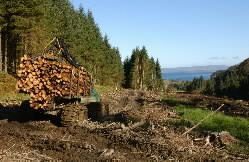
UK forest carbon balance
The amount of carbon held in the UK’s 3.2 million hectares of woodlands and forests is estimated at 1,095 Mt C (million tonnes of carbon, or 4,016 million tonnes of CO2 equivalent).
While the large amounts of carbon in the trees are most obvious to us in the stems, branches and woody roots, about 70% of the carbon held in UK forests is in the soil (calculated only for the top 1 metre; peat soils in some locations may be much deeper). This very large amount of C in forests is equivalent to about 12 times our present annual UK carbon dioxide emissions, emphasising the role of our forests and woodlands as a carbon store, and how important it is to maintain and expand them.
Importantly, the UK’s woodland and forests are taking up about 4.8 Mt C per year (17.5 Mt CO2 per year), reducing our net emissions. Expanding the UK woodland and forests will therefore help reduce net GHG emissions. In addition, increasing the amount of C held in long-lived forest products like construction timber will also help sequester carbon, and will help reduce the use of fossil-fuel intensive materials like metals, bricks and concrete.
In addition, harvesting trees for wood fuel for heating or power generation instead of using fossil fuels, can cause a net emissions’ reduction, if the rate of growth of replacement trees is sufficient to absorb the CO2 released during wood fuel production and consumption.
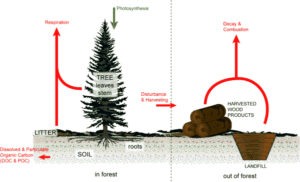
Diagram showing the components of the forestry carbon cycle in the forest and outside.
Photosynthesis (green arrow) removes CO2 from the atmosphere and results in the accumulation of carbon in the woody parts of the trees and the soil; carbon can be lost (red arrows) from the forest through respiration and decomposition, natural disturbances or from harvesting. Harvested wood products can form long-term stores e.g. in construction.
Our Involvement
Forest Research carries out long-term research on understanding the carbon and greenhouse balance of forests and forestry. This research includes reviews, measurements and modelling at stand, forest and national scales. In the forest, we have been continuously measuring the second-by-second exchange of carbon and other greenhouse gases between the forest and the atmosphere in a lowland oak stand since 1998 (one of the longest measurement series globally) and have recently compared this with an upland spruce plantation. We have an extensive database on soil carbon stocks from detailed sampling across the UK. We are developing models of how tree growth and carbon uptake are affected by the changing climate, particularly changing drought risk. We provide national statistics on the amounts of carbon in our woodlands and forests, supply essential modelled estimates of the contribution of UK woodland and forests to the national greenhouse gas accounts and provide national and international assessments of the role of forestry and forest management in emissions mitigation.
Forest Research is a partner in several UK and international research projects on mitigation, for example ‘Net Zero+’.
General Content
There are close links to several other Forest Research programmes:
- Forest hydrology & soils
- Climate change adaptation
- Land use and ecosystem services and economics