
Summary
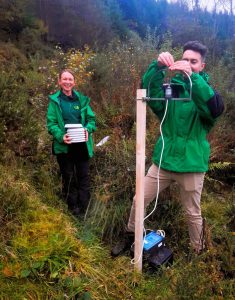
The Welsh Plant Health Surveillance Network (WPHSN) is a ground-breaking Welsh Government funded project designed to monitor native and invasive pests and pathogens that can pose a threat to health of plants and trees across Wales. Insect and spore monitoring stations installed at strategic woodland sites will allow us to record presence and/or abundance of insects and fungal spores. Biological samples are obtained and analysed by the WPHSN team using laboratory facilities at Swansea University. Samples collected as part of GB-level wider environment monitoring for the bark beetle Ips typographus are sent to our state-of-the-art plant health facilities at Alice Holt for laboratory testing.
Full reviews of the annual fieldwork campaigns are available for download below. These documents describe and report on the activities undertaken in each year of this innovative project.
Research Objectives
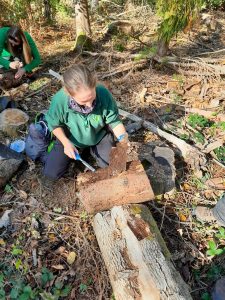
The objective of this ongoing research is to deliver the tree-based component of the Welsh Plant Health Surveillance Network (WPHSN), a Welsh Government plant health initiative. Biological samples are collected and analysed by FR staff based in Wales, with support from the Tree Health Diagnostic and Advisory Service laboratory staff based at Alice Holt and the Northern Research Station. Within the WPHSN, we will:
- deploy spore and insect monitoring stations across Welsh woodlands;
- collect data and build a distribution map of pests and pathogens, recording their abundance;
- assist with decision-making processes and informing the development of future policies and procedures relating to woodland management in Wales; and
- work with external agencies to grow the plant health surveillance network; and
- share information and advice with the sector and provide accessible practical support for the early detection and identification of tree pests and pathogens in Wales.
Latest Update
2025 – the fourth season
- Insect monitoring stations were deployed across Wales in broadly the same pattern as adopted in previous years with the addition of some Sitka spruce sites that had suffered wind damage as a result of Storm Darragh.
- Cross-vane traps were deployed for the detection of Ips typographus and Ips cembrae bark beetles, and 47 funnel traps for the detection of other insect species, including oak processionary moth (OPM), Agrilus beetles, and Monochamus alternatus.
- A total of 12 air samplers were deployed across Wales in both conifer and broadleaf woodlands. Samples are being analysed for a range of target airborne pathogens.
- Collaboration with the sentinel site network, our forestry colleagues in England and Scotland, and our external colleagues at Welsh Government and Natural Resources Wales further increased in 2025.
- We welcomed Dr Matthew Watkins to the team to support the fieldwork element of the WPHSN and to conduct the laboratory analysis of airborne samples.
2024 – the third season
- A total of 86 insect traps were deployed across Wales in broadly the same pattern as adopted in 2022 and 2023.
- Of these, 29 were cross vane-traps for the detection of Ips typographus, Ips amitinus, and Ips cembrae bark beetles, and 57 were canopy insect traps for the detection of other insect species, including oak processionary moth (OPM), gypsy moth, and Agrilus beetles.
- The fungal spore traps deployed in 2024 suffered repeated mechanical failures which prevented the collection of useable DNA samples within the season.
- Collaboration with the sentinel site network has further increased in 2024.
2023 – the second season
- A total of 67 insect traps and 6 spore traps were deployed across Wales, again utilising the ‘J’ formation and a south-north axis line to ensure adequate geographic coverage around potential pathways.
- 33 cross vane-traps for the detection of Ips typographus and Ips cembrae bark beetles were established in carefully selected high risk sites across Wales.
- 34 canopy insect traps were deployed in the Welsh Government Woodland Estate (managed by Natural Resources Wales) and at sentinel sites across Wales, primarily for the detection of oak processionary moth (OPM) and Agrilus spp.
- Fungal spore traps remain deployed at Talybont-on-Usk and at the National Botanic Gardens of Wales (NBGW), with additional surveillance carried out at The Cott in Southeast Wales.
- Collaboration with the sentinel site network has continued, with more sites coming on board this year and into 2024.
2022 – the first season
- A total of 33 insect traps and 2 spore traps were deployed in a J-shaped arrangement from mid to south Wales. The location of traps was informed by previous work led by Professor Hugh Evans.
- 20 cross-vane traps were set up, primarily for the detection of Ips typographus and Ips cembrae bark beetles.
- A further 13 canopy insect traps were deployed on parts of the Welsh Government Woodland Estate (managed by Natural Resources Wales) and at two of the sentinel sites; Loggerheads Country Park and at the National Botanic Gardens of Wales (NBGW). A number of these traps were installed between June and August for the detection of oak processionary moth (OPM) and Agrilus species.
- Fungal spore traps were deployed at Talybont-on-Usk and at the NBGW.
- Collaboration was initiated with staff managing some of the Wales plant health sentinel sites – initially those at NBGW, Loggerheads Country Park, Powis Castle, and Plas Newydd (Anglesey).
Our Involvement
- Research and development activities.
- Field surveys.
- Laboratory analyses.
- Data recording.
- Reporting to plant health officials in Wales.
- Collaboration with external agencies.
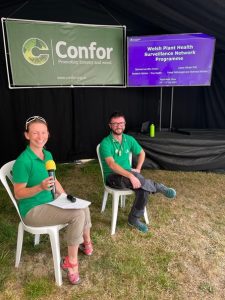
- Developing public awareness e.g., through knowledge exchange activities, digital media, and at the Royal Welsh Agricultural Show.
Downloads
Welsh Plant Health Surveillance Network Programme: 2024 review
An account of the activities and outcomes from the third full year of fieldwork.
Welsh Plant Health Surveillance Network Programme: 2023 review
An account of the activities and outcomes from the second full year of fieldwork.
Welsh Plant Health Surveillance Network Programme: 2022 review
An account of the activities and outcomes of the first year of this study.
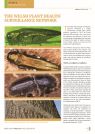
The Welsh Plant Health Surveillance Network
Racheal Lee (2024) The Welsh Plant Health Surveillance Network BGjournal. Volume 21 (2), pp. 60-62. (Reproduced by kind permission of Botanic Gardens Conservation International.)
Welsh Plant Health Surveillance Network Programme: 2025 review
Rhwydwaith Gwyliadwriaeth Iechyd Planhigion Cymru: adolygiad 2025
Funding & Partners
-
 This work is funded by the Welsh Government.