Research
Climate change in Scotland
Research Status:current
We use some essential cookies to make this website work.
We’d like to set additional cookies to understand how you use forestresearch.gov.uk, remember your settings and improve our services.
We also use cookies set by other sites to help us deliver content from their services.

For a detailed discussion of the changes in Scotland’s climate between 1961 and 2004 see:
 A handbook of climate trends across Scotland.
By C. Barnett, J. Hossell, M. Perry, C. Procter, and G. Hughes.
Sniffer Project CC03, Scotland and Northern Ireland Forum for Environmental Research.
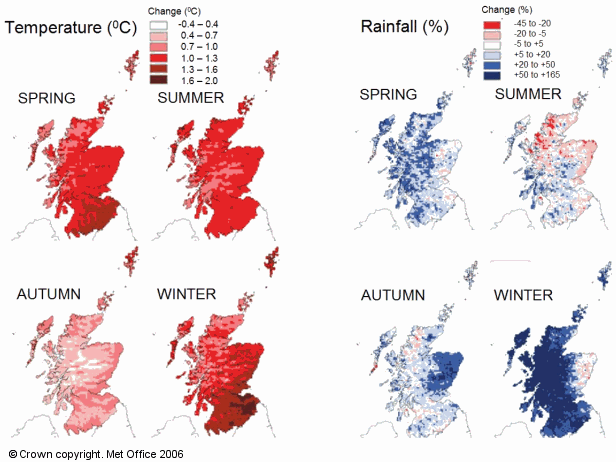
Regional variations in seasonal mean temperatures have occurred in the last 40 years. Between 1961 and 2004 winters have become milder by as much as 2°C in parts of south-east Scotland. Springs and summers are generally about 1°C warmer across Scotland now than in the early 1960s.
Regional changes have occurred in the total annual rainfall between western and eastern Scotland. Between 1961 and 2004, Scotland experienced a 20% increase in precipitation, due to a large increase (50%) in the total winter precipitation, particularly in northern and western Scotland. Eastern Scotland has experienced a smaller 30% increase in winter precipitation.
Cookies are files saved on your phone, tablet or computer when you visit a website.
We use cookies to store information about how you use the dwi.gov.uk website, such as the pages you visit.
Find out more about cookies on forestresearch.gov.uk
We use 3 types of cookie. You can choose which cookies you're happy for us to use.
These essential cookies do things like remember your progress through a form. They always need to be on.
We use Google Analytics to measure how you use the website so we can improve it based on user needs. Google Analytics sets cookies that store anonymised information about: how you got to the site the pages you visit on forestresearch.gov.uk and how long you spend on each page what you click on while you're visiting the site
Some forestresearch.gov.uk pages may contain content from other sites, like YouTube or Flickr, which may set their own cookies. These sites are sometimes called ‘third party’ services. This tells us how many people are seeing the content and whether it’s useful.