Research
Impacts of large herbivores on woodlands
Research Status:completed

The aim of this programme was to improve our advice both on reducing the damage caused by large herbivores and on the use of large herbivores as a management tool to achieve biodiversity objectives. The project is now discontinued but has been included for information and advice.

Most of this work forms part of the Vertebrate management research programme funded by the Forestry Commission.
Work on some projects is performed in partnership with and is funded by other institutions and organisations.
The Forestry Commission implements Government policy on both woodland biodiversity and sustainability. Deer and stock can have a major impact on both the biodiversity value of woodlands and on their sustainable management. Our research improves the guidance we provide to woodland managers on achieving the desired impact.
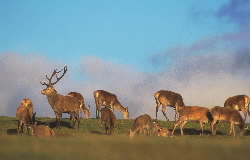
This programme is using wild deer in Britain as a case study to produce frameworks for the development of effective, collaborative and sustainable management of natural resources in Britain.
Deer management provides jobs in forestry, on sporting estates and in the meat industry, and tourists are drawn to particular landscapes, which deer help to create, to see the deer themselves. However, in some areas, high numbers of deer are causing overgrazing and damage to sensitive natural habitats, agricultural and forestry crops and suburban gardens. Deer are also increasingly involved in road traffic accidents. Therefore there are many different attitudes to deer and conflicts on how best to manage them.
The programme investigates the extent to which people that can and should influence deer management are aware of all the issues involved. It is examining how well people currently involved in deer management work together and how this can be improved so that the costs of managing deer are minimised and the benefits maximised.
Programme newsletters
Published/in press papers
Forest Research social scientists are contributing significantly to the project as a whole, but with a specific focus upon qualitative research:
The Forest Research also is contributing significantly to the project as a whole, particularly through:
The programme commenced in February 2006 and reported in March 2010. Progress of the study was reported through the Project Newsletter and presentations to meetings and conferences. A list of data sets created during the project along with published outputs is available.
Social and economic research
Project interdisciplinarity and social research
Herbivore impacts on woodland ecosystems
The interdisciplinary project team consists of ecologists, economic and social scientists from seven institutions:
This research is funded by the Rural Economy and Land Use Programme of the UK Research Councils. The Forestry Commission is supporting the project through its Impacts of large herbivores on woodlands programme.
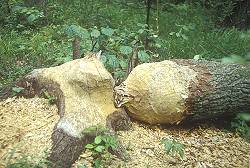
In 2003 Scottish Natural Heritage commissioned Forest Research to test methods of monitoring the impact of beavers on woodland vegetation in the re-introduction site in Knapdale, Scotland. The methods provide an assessment of damage by beavers as well as by deer that may browse the re-growth of trees that beavers have felled.
The report describes a field test of a method as well as suggesting improvements to the methods and approaches to undertaking full-scale monitoring.
Armstrong, H. M., Poulsom, L., Simson, P., Wilson, J and Tracy D. (2003). Testing methods for monitoring beaver impacts on terrestrial vegetation in Knapdale. Scottish Natural Heritage Commissioned Report. 50 pp. Scottish Natural Heritage, Battleby.
SNH Scottish Beaver trial pages
Completed
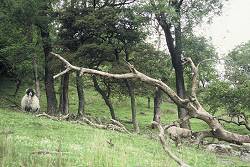 Woodlands in upland parts of Britain have been traditionally used as shelter for livestock. However overgrazing can often occur, with detrimental effects on woodland condition. With the advent of the Single Farm Payment and cross compliance with Good Agricultural and Environmental Condition, methods are needed to assess when unacceptable conditions are caused by overgrazing.
Under a contract funded by Defra, English Nature and the Forestry Commission, a method has been developed to assess grazing levels in woodland.
This project is now complete and a full report and description of the method is available as an English Nature report in PDF format:
Thompson, R. Peace, A. Poulsom, L. (2005) A judgement – based method to identify overgrazing in English upland native woodlands. English Nature Research Reports, No. 621.

Most of this work forms part of the Vertebrate management research programme that is funded by the Forestry Commission.




Work on collaborative deer management is in partnership with the Macaulay Institute and the universities of Aberdeen, Edinburgh, Kent, St. Andrews and York. It is funded by the Forestry Commission and by the UK Research Councils through their Rural Economy and Land Use fund.




Work on the woodland grazing toolbox is in partnership with the Scottish Agricultural College and the Farming and Woodland Advisory Group Scotland. It is funded by Forestry Commission Scotland and Scottish Natural Heritage.


Work on indicators of deer population health and performance is in partnership with the Macaulay Institute and is funded by the Scottish Government.

Work on methods of assessing the level of grazing in upland woods was funded by the Department for Environment, Food and Rural Affairs, English Nature and the Forestry Commission.

Work on methods of assessing the impact of beavers on woodland vegetation was funded by Scottish Natural Heritage.
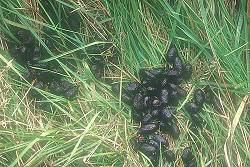
Estimates of population deer population density are useful in guiding management decisions relating to the need and effectiveness of deer management. However, experience with methods based on direct counts often yielded serious under-estimates in forested environments, so alternative approaches have been developed.
Initial investigations focussed mainly on faecal pellet counts as a method that would be suitable for use in dense forest vegetation. This approach relied on estimation of the rates of deposition and disappearance of pellet groups, and have been described, along with other methods and sampling considerations in:
Mayle, B. Peace, A. Gill, R. (1999) How many deer? – a guide to estimating deer population size. Field Book 18, Forestry Commission, Edinburgh.
Later studies, developed in collaboration with Strath Caulaidh Ltd. indicated that methods based on counts of pellets obtained in two successive visits in marked plots could be more efficient, particularly in upland environments.
Campbell, D., Swanson, G.M. and Sales, J. (2004). Comparing the precision and cost-effectiveness of faecal pellet group count methods. Journal of Applied Ecology, 41, 1185-1196).
A full description, and justification, of the method appears in:
Swanson, G, Campbell, D & Armstrong, H. (2008). Estimating deer abundance in woodlands: the combination plot technique. Forestry Commission Bulletin no. 128. Forestry Commission, Edinburgh.
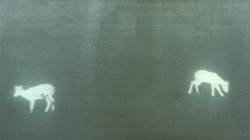
The use of thermal imaging was also developed for estimating deer population density. Thermal imagers detect the radiant heat energy emitted from warm-bodied animals, and can make nocturnal and camouflaged animals highly conspicuous. Large mammals can be detected at distances of up to 2 km. Heat energy cannot however pass through solid objects, so animals can be concealed by vegetation. Since 1995, methods have been developed to obtain estimates of population density and trend using distance sampling, which removes bias caused by varying vegetation density. Observations are made at night, when deer are more likely to make use of fields or open areas.
This approach has proved very effective in the lowlands, where dense coniferous thicket vegetation is less extensive than in the uplands. Thermal imaging can also provide information on deer species composition, group sizes and habitat use.
Gill R.M.A., Thomas, M.L. and Stocker, D. (1997). The use of portable thermal imaging for estimating deer population density in forest habitats. Journal of Applied Ecology, 34 1273-1286.
More recently, this approach has been adapted for use on wild boar.
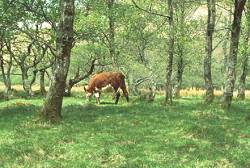
Cattle are thought to provide biodiversity benefits in woodlands when grazed at low density since they eat dense vegetation of a low digestibility and break up vegetation mats with their hooves. This opens up the ground layer vegetation and is thought to be beneficial for tree regeneration as well as leading to a greater variety of vegetation types and associated invertebrate and bird assemblages. Because of these perceived benefits there is increasing interest in the use of cattle as a tool for nature conservation management in woodlands. Little information was available, however, with which the impacts of a given cattle grazing regime on a particular woodland could be predicted. Indeed there had been virtually no published studies of the impact of cattle on woodlands in Britain and very few in other countries. Additionally, there was little information available on the current use of woodlands for cattle grazing in Britain.
A survey of grazing in woodlands was carried out with the principal objectives of determining the extent of cattle grazing in woodlands, the site manager’s objectives and the impacts on trees and other vegetation. The survey was completed in 2005 with the production of the following report:
Report on the Survey of Cattle-grazed Woodland in Britain (PDF-667K)
Most woodlands grazed by cattle are small (<50ha) and not well suited for low-density year round grazing, however alternative grazing was available at most sites.
In Scotland, most owners are private having livestock production as a key objective whereas in England and Wales more owners are public or NGO’s with conservation as a primary objective.
In terms of conservation, the range of objectives for grazing included maintenance of open habitats, either the reduction or encouragement of tree regeneration, or to benefit certain species.
Tree regeneration declined with increasing stocking rates, however the association was weak. This was considered to be due, in part, to the presence at most sites of other herbivores, as well as alternative grazing for cattle.
Tree species most likely to be browsed by cattle included Oak and willow whereas those most commonly avoided included Holly and Hawthorn.
The establishment of control areas is recommended both to inform site managers and to provide a basis for more consistent predictions of the impact of grazing.
Related publications on grazing management
Andrews, J., Miller, G.R. & Armstrong, H.M. (2000). The effects of mammalian herbivores on natural regeneration of upland, native woodland. Scottish Natural Heritage Information and Advice Note No. 115. Scottish Natural Heritage, Battleby, Perthshire.
Fuller, R.J. and Gill R.M.A. (2001). Ecological impacts of increasing numbers of deer in British woodland. Fuller R.J. and Gill, R.M.A. (Eds) Special Issue, Forestry 74 193-199.
Gill, R.M.A. (2000). The impact of deer on woodland biodiversity (PDF-127K). Forestry Commission Information Note, 36.
Gill, R.M.A. (2006). The influence of large herbivores on tree recruitment and forest dynamics. Chapter 6 In: Danell K., Bergstrom, R. and Rooke T. (eds) The Impact of Large Mammalian Herbivores on Biodiversity, Ecosystem Structure and Function. Cambridge University Press, Cambridge, UK.
Gill, R.M.A. (2004). Population increases, impacts and the need for management of deer in Britain. In: Managing woodlands and their mammals. C. Quine, R. Shore and R. Trout (Eds). Forestry Commission, Edinburgh. 55-60.
Gill R.M.A. (2003). The economic implications of deer damage in woodlands and forests. In: Goldberg E. (Ed) The future for deer: The Deer Initiative Conference, 28-29 March 2003. English Nature Research Reports 548, p26-31 Peterborough.
Gill R.M.A. (1992). A review of damage by mammals in north temperate forests: 1. deer. Forestry 65 145-169.
Gill R.M.A. (1992). A review of damage by mammals in north temperate forests: 3. impact on trees and forests. Forestry 65 363-388.
Gill, R.M.A. & Beardall, V. (2001). The impact of deer on woodlands: the effects of browsing and seed dispersal on vegetation structure and composition. Fuller R.J. & Gill, R.M.A. (Eds) Special Issue, Forestry 74 209-218.
Gill, R.M.A. & Fuller, R.J. (2007). The effects of deer browsing on woodland structure and songbirds in lowland Britain Ibis 149 119-127.
Gill, R.M.A. & Morgan, G. (2010). The effects of varying deer density on natural regeneration in woodlands in lowland Britain. Forestry 83: 53-63.
Gill, R.M.A., Webber, J. Peace, A. (2001). The economic implications of deer damage: a review of current evidence. The Deer Commission for Scotland, Annual Report 1999-2000 p48-49.
Gill R.M.A., Gurnell J. & Trout, R.C. (1995). Do woodland mammals threaten the development of new woods? In: Ferris-Kaan, R. (Ed) The Ecology of Woodland Creation, p200-224. John Wiley & Sons, Chichester.
Harmer, R. & Gill, R. (2000). Natural regeneration in broadleaved woodlands: deer browsing and the establishment of advanced regeneration (PDF-121K). Forestry Commission Information Note 35.
Harmer, R., Kiewitt, A., Gill, R. & Morgan, G. (2010). Does the development of bramble (Rubus fruticosus L. agg) facilitate the growth and establishment of tree seedlings in woodlands by reducing deer browsing damage? Forestry. 83: 93-102.
Irvine, R.J., Broadmeadow, M., Gill., R.M.A. & Albon, S. D. (2007). Deer & Global warming: How will climate change influence deer populations, Deer, Autumn 2007, 34-37.
Milne, J.A., Birch, C.P.D., Hester, A.J., Armstrong, H.M., & Robertson, A. (1998). The impact of vertebrate herbivores on the natural heritage of the Scottish uplands – a review. SNH Review series No. 95. Scottish Natural Heritage, Battleby, Perthshire.
Armstrong, H.M. & Bullock, D.J. (2004). Stock grazing in woodlands. In: Managing woodlands and their mammals. C. Quine, R. Shore and R. Trout (Eds). Forestry Commission, Edinburgh. 81-86.
Armstrong, H. M., Poulsom, L, Connolly, T. & Peace, A. (2003). A survey of cattle-grazed woodlands in Britain. Report to the Forestry Commission (PDF-667K). October 2003. 65 pp.
Armstrong, H.M. & Smith, M. (2008) Woods and trees in the uplands – why we might want more. Aspects of Applied Biology, 85, ‘Shaping a vision for the Uplands’. 1-4.
Gill, R. & Armstrong, H.M. (2005). Cattle and Woodlands. In: Deer and Cattle in Woodlands. Proceedings of a workshop held at Marlborough College. 17th December 2004. J. Batten (ed.) English Nature, the Deer Initiative. 10-12.
Hester, A. Kirby, K., Mitchell, F. Gill R., Latham, J. & H. Armstrong (1998). Ungulates and forest management in the British Isles. Chapter 4 In: Humphrey, J., Gill, R.M.A. and Claridge, J. (Eds). Grazing as a management tool in European forest ecosystems. Forestry Commission Technical Paper 25.
Mayle, B. (1999). Domestic stock grazing to enhance woodland biodiversity (PDF-7294K). Forestry Commission Information Note 28. Forestry Commission, Edinburgh.
Armstrong, H.M., Gill, R.M.A., Mayle, B.A. & Trout, R.C. (2003). Protecting trees from deer: an overview of current knowledge and future work. Forest Research Annual Report, 2001-2002. The Stationary Office, Edinburgh.
Armstrong, H.M., Bathgate, S. & Handley, P. (2007). Excel red deer population dynamics model. Available from: helen.armstrong@forestry.gsi.gov.uk.
Chapman, N.G. & Chapman, D.I. (1982). The fallow deer. Forestry Commission Forest Record, 124.
Dolman, P., Fuller, R., Gill, R., Hooton, D. & Tabor, R. (2010). Escalating ecological impacts of deer in lowland woodland. British Wildlife April 2010 p242-254.
Gill R.M.A. (2001). The deer explosion. Tree News Autumn/Winter 2001.
Gill R.M.A., Johnson A.L., Francis A., Hiscocks K. & Peace A.J. (1996). Changes in roe deer (Capreolus capreolus L.) population density in response to forest habitat succession. Forest Ecology and Management 88 31-41.
Mayle, B. (1999). Managing deer in the countryside (PDF-7884K). Forestry Commission Practice Note, 6.
Mayle, B. Gill, R. & Pepper, H. (1998). Management of deer in the lowlands. Forest research annual report and accounts 1997-98. Forestry Commission, Edinburgh. Pages 51-55.
Ratcliffe, P.R. & Mayle, B.A. (1992). Roe deer biology and management. Forestry Commission Bulletin, 105.
Ratcliffe, P.R. (1987). The management of red deer in upland forests. Forestry Commission Bulletin, 71.
Ratcliffe, P.R. (1985). Glades for deer control in upland forests. Forestry Commission Leaflet, 86.
Springthorpe, G.D. & Myhill, N.G. (1994). Wildlife rangers handbook. Forestry Commission Handbook, 10. (Sections on deer management).
Campbell, D. Swanson, G.M. & Sales, J. (2004). Comparing the precision and cost-effectiveness of fecal pellet group count methods. Journal of Applied Ecology 41 1185-1196
Gill R.M.A., Thomas, M.L. & Stocker, D. (1997). The use of portable thermal imaging for estimating deer population density in forest habitats. Journal of Applied Ecology, 34 1273-1286.
Hemami, M.R., Watkinson, A. Gill, R.M.A. & Dolman, P. (2007). Estimating abundance of introduced Chinese muntjac Muntiacus reevesi and native roe deer Capreolus capreolus using portable thermal imaging. Mammal Review 37 246-254.
Mayle, B., Doney, J., Lazarus, G., Peace, A. & Smith, D. (1996). Fallow deer (Dama dama L.) defecation rate and its use in determining population size. Suppl. Ric. Biol. Selvaggina XXV 63-78.
Mayle, B., Peace, A. & Gill, R. (1999). How Many Deer? A guide to estimating deer population size. Forestry Commission field book 18. Forestry Commission, Edinburgh. 96p
Mayle, B.A., Putman, R. & Wyllie, I. (2000). The use of trackway counts to establish an index of deer presence. Mammal Review 30 233-237.
Swanson, G., Campbell, D. & Armstrong, H. (2008). Estimating deer abundance in woodlands: the combination plot technique. Forestry Commission Bulletin no. 128. Forestry Commission, Edinburgh.
Armstrong, H. M., Poulsom, L., Simson, P., Wilson, J. &Tracy D. (2003). Testing methods for monitoring beaver impacts on terrestrial vegetation in Knapdale. Scottish Natural Heritage Commissioned Report No.26. 50 pp.
Ferris, R. & Carter, C. (2000). Managing rides, roadsides and edge habitats in Lowland forests. Forestry Commission Bulletin 123.
Ferris-Kaan, R. & Patterson, G.S. (1992). Monitoring vegetation changes in conservation management of forests. Forestry Commission Bulletin, 108.
Melville, R.C., Tee, L.A. & Rennolls, K. (1983). Assessment of wildlife damage in forests. Forestry Commission Leaflet, 82.
Pepper, H. (1998). Nearest neighbour method for quantifying wildlife damage to trees in woodland (PDF-139K). Forestry Commission Practice Note, 1.
Reimoser, F, Armstrong, H. & Suchant, R. (1999). Measuring forest damage of ungulates: what should be considered. Forest Ecology and Management, 120, 47-58.
Thompson, R., Peace, A. & Poulsom, L. (2005). A judgement – based method to identify overgrazing in English upland native woodlands. English Nature Research Reports, No. 621.
Armstrong, H.M. (1996). The grazing behaviour of large herbivores in the Scottish uplands. Scottish Natural Heritage Information and Advisory Note No. 47. Scottish Natural Heritage, Battleby.
Armstrong, H.M. & Robertson, A. (2000). Energetics of free-ranging large herbivores: when should costs affect foraging behaviour? Canadian Journal of Zoology, 78 (9), 1604-1615.
Vertebrate Ecologist