
Summary
Summary
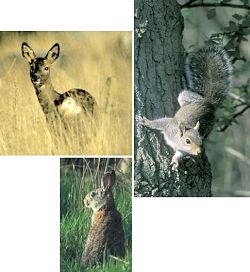
Damage by some woodland mammals can have a significant impact on trees of all ages and on the wider woodland ecosystems by:
- Preventing tree establishment, healthy growth or good timber quality
- Preventing the development of a structurally diverse shrub layer
- Reducing the abundance of palatable plants such as bramble, bluebell, dog’s mercury and honeysuckle
- Increasing the abundance of grasses and unpalatable species such as bracken, rushes and ragwort
Status
Resources for research are limited, and this project is now closed. We will continue to provide advice on best practice and methods of tree protection.
Funders and partners

This research is funded by the Forestry Commission Vertebrate management programme.
Forestry Commission policy
Prevention of mammal damage to enhance establishment, regeneration and woodland biodiversity is acknowledged in the Forestry Strategies for:
Mammal damage to trees and woodlands – further reading
Mayle, B., Ferryman, M., Pepper, H. (2007). Controlling grey squirrel damage to woodlands. Forestry Commission Practice Note 4 (Revised). Forestry Commission, Edinburgh.
Trout, R.C. & Pepper, H.W. (2006). Forest fencing. Forestry Commission Technical Guide, Forestry Commission, Edinburgh.
Mayle, B., Pepper, H., Ferryman, M. (2004). Controlling grey squirrel damage to woodlands. Forestry Commission Practice Note 4 (Revised). Forestry Commission, Edinburgh.
Gurnell, J., Lurz, P.W.W., Pepper, H. (2001). Practical techniques for surveying and monitoring squirrels. Forestry Commission Practice Note 11, Forestry Commission, Edinburgh.
Harmer, R. & Gill, R. (2000). Natural regeneration in broadleaved woods: deer browsing and the establishment of advanced regeneration. Forestry Commission Information Note 35, Forestry Commission, Edinburgh.
Gill, R. (2000). The impact of deer on woodland biodiversity. Forestry Commission Information Note 36, Forestry Commission, Edinburgh.
Mayle, B. A. (1999). Managing deer in the countryside. Forestry Commission Practice Note 6, Forestry Commission, Edinburgh.
Mayle, B.A. (1999). How many deer? A guide to estimating deer population size, Forestry Commission Field Book, Forestry Commission, Edinburgh.
Hodge, S. & Pepper, H. (1998). The prevention of mammal damage to trees in woodland. Forestry Commission Practice Note 3, Forestry Commission, Edinburgh.
Pepper, H. (1998). Nearest neighbour method for quantifying wildlife damage to trees in woodland. Forestry Commission Practice Note 1, Forestry Commission, Edinburgh.
Pepper, H.W. (1998). The prevention of rabbit damage to trees in woodland. Forestry Commission Practice Note 2, Forestry Commission, Edinburgh.
Mayle, B.A. (1994). Roe deer biology and management, Forestry Commission Bulletin 105, Forestry Commission, Edinburgh.
Wildlife Rangers Handbook (1994). Forestry Commission Management Handbook, Forestry Commission, Edinburgh.
Pepper, H.W. (1992). Forest fencing, Forestry Commission Bulletin 102, Forestry Commission, Edinburgh.