Research
Continuous cover silviculture
Research Status:current

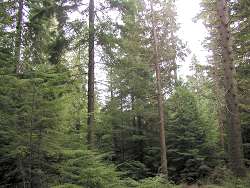 Continuous cover is an approach to forest management that seeks to create more diverse forests, both structurally and in terms of species composition, by avoiding clearfelling. The development of more diverse forests is a sensible way to reduce the risks posed by future changes in the climate and biotic threats.
The aims of this research programme are to:
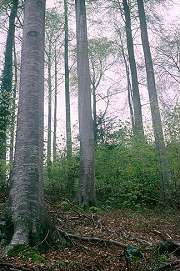 The medium term objectives are:
Work in the programme is divided into a number of projects and studies:
The following people also work on the programme:
Team members work closely with colleagues in the Technical Services and other parts of Forest Research.

This research is funded by the Forestry Commission Regeneration and sustainable silviculture programme.


Other funders include the Scottish Forestry Trust and REINFFORCE (An INTERREG project of the EU).
The project works in close partnership with Forestry Commission Scotland at the Glentress CCF Trial Area and Forestry Commission Wales at Clocaenog CCF Research Area. Two members of the team also sit on the Forestry Commission CCF Working Group.
Forestry Commission policy
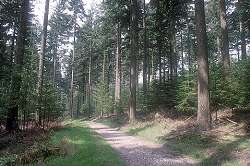 Continuous cover silviculture is now being widely practised in British forests and it has recently been estimated that greater than 10% of all Forestry Commission woodlands use it. There is no doubt that this percentage will increase because of policy developments. For example in Wales diversifying approaches to management is a key strategic objective in Woodlands for Wales (Forestry Commission Wales, 2009) that seeks to ‘avoid clearfelling on our own woodland estate whenever alternative management methods would deliver a wider range of ecosystem services’. In addition, the United Kingdom Woodland Assurance Scheme 2006 (UKWAS) requires forest managers to ‘increasingly favour’ CCF in windfirm conifer plantations and semi-natural woodland.
The Forestry Commission’s Science and Innovation strategy for British forestry (Forestry Commission, 2010) has recognised the changes outlined above and made diversifying approaches to forest management one of seven research themes.
Practical implementation of silvicultural prescriptions.
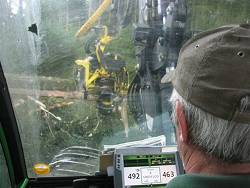
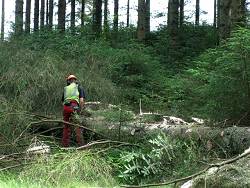
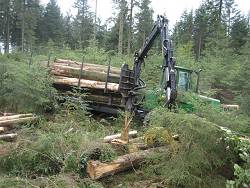
Provide forest managers with useful and relevant guidance on operational aspects of continuous cover silviculture.
A number of projects within the programme are examining the scientific basis for this type of silviculture and making recommendations on regeneration and stand interventions. The main focus of this project is to produce guidance for forest mangers on how these recommendations can be put into practice using modern methods and equipment, within the current regulatory framework for forestry in Britain.
An important link for the project will be the 12 long-term, large scale CCF (Continuous Cover Forestry) demonstration woodlands established by the Forestry Commission since 2000 (McIntosh, 2000). At one of these demonstration woodlands, Trallwm in Wales, a joint Forest Research/University of Wales study has been carried out with Professor Colin Price and Martin Price (Price and Price, 2006).
In addition, there are many forest managers in the non-state sector who have valuable operation experience of managing forests in transformation or as CCF and it will be important for the project to make the best use of this valuable expertise.
Ireland, D. (2009). Final Overstorey Removal in Uniform Shelterwood (PDF-1265K). Forestry Commission Technical Development Internal Project Information Note 45/08. Technical Development, Ae Village.
Ireland, D. and Kerr, G. (2008). CCF Harvesting Method Development: Harvester Head Visibility (PDF-474K). Forestry Commission Technical Development Internal Project Information Note 10/08. Technical Development, Ae Village.
Ireland, D. (2007). Transformation Thinning in CCF with Advanced Natural Regeneration, Case Study: Clocaenog, North Wales. Forestry Commission Technical Development Internal Project Information Note 21/07. Technical Development, Ae Village.
Ireland, D. (2006). Operational Experience of Continuous Cover Forestry: UK Case Studies (PDF-5381K). Forestry Commission Technical Development Internal Project Information Note 13/06. Technical Development, Ae Village.
Price, M. and Price, C. (2006). Creaming the best, or creatively transforming? Might felling the biggest trees first be a win-win strategy? Forest Ecology and Management 24(3): 252-257.
McIntosh, B. (2000). Role of continuous cover silvicultural systems in the management of the Forestry Commission estate. CCFG Newsletter 16: 5-9. Continuous Cover Forestry Group, Tyddyn Bach, Llanegryn, Tywyn, Gwynedd, LL36 9UF.
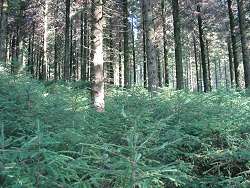
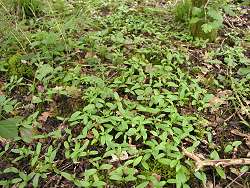
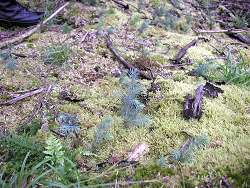
Transformation of forests to continuous cover management requires successful establishment and growth of seedlings beneath a canopy, and their subsequent recruitment into the overstorey.
This can be achieved by natural regeneration or by planting. Previously the focus of work in the project has been on natural regeneration and this has shown that for the best chances of success with natural regeneration you need:
Guidance on using natural regeneration in continuous cover forests can be found in ( Kerr 2008).
Other work in the project has developed a simple method to assess the likelihood of natural regeneration of Sitka spruce, Scots pine, Douglas-fir and larch. Full details of this method and how managers can apply it in the field are reported respectively in the following papers:
Current work is now focussing on underplanting:
Garry Kerr and Victoria Stokes
Hale, S.E. (2004). Managing Light to Enable Natural Regeneration in British Conifer Forests (PDF-100K). Information Note 63. Forestry Commission, Edinburgh. 6 pp.
Kerr, G. (2008) Managing Continuous Cover Forests. Forestry Commission Operational Guidance Booklet 7. Forestry Commission, Edinburgh.
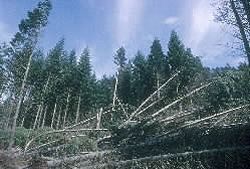
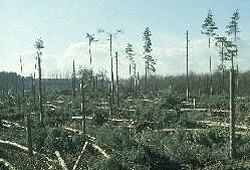
To produce a wind risk model that can be applied to any stand structure.
Existing work on the stability of forests has concentrated on the risk of wind damage to even-aged single-species conifer stands. However, other forms of forest management have increased in prevalence, such as silvicultural systems associated with continuous cover forestry. There is therefore a growing need to understand the stability of forests being transformed and managed under CCF, and of trees growing in mixed-species stands. This involves a change in emphasis from stand-level to tree-level risk.
ForestGALES is a PC-based wind risk decision support tool, developed by FR for use in even-aged conifer monocultures. Recent experimental work and analysis of historic data have enabled us to develop the underlying science to calculate risk to individual trees in stand with an irregular structure, and to add several broadleaf species into ForestGALES.
For further information see “Tree stability and wind risk to forests” page.
ForestGALES
PC-based decision support tool that enables forest managers to estimate the probability of wind damage to any conifer stand in Britain.
Further details about ForestGALES
A recent study by Forest Research has shown that transformation to continuous cover forestry (CCF) can be a good economic option compared with clearfelling and replanting (C&R): see the Study report (PDF-691K). It is hoped the findings of the work will alleviate concerns that transformation to CCF is always a costly option.
The study examined the costs and revenues associated with three transformation scenarios for a stand of Sitka spruce (GYC14) and compared them with conventional C&R. A flexible yield model was used to predict the growing stock and harvesting yields for programmes of thinnings which follow current guidance. Detailed information on the costs of operations was obtained from work study reports, England Woodland Grant Scheme standard costs and the experience of Forestry Commission staff in CCF Trial Areas.
Transformation scenarios were less costly than C&R over a 20-year period because of high initial thinning returns. In the longer term, transformation to a simple CCF structure was similar to or better than C&R if successful natural regeneration could be obtained. The results were tested for their sensitivity to changes in the level of management overheads (assumed to be higher for transformation), product prices and discount rate. The changes investigated had relatively little effect on the ranking of scenarios.
The report is accompanied by an Analysis spreadsheet (MS Excel®-3813K) that enables practitioners and policymakers to change input costs, product specifications, roadside prices and the discount rate to suit their local conditions.
The work was completed on behalf of the Forestry Commission’s Working Group on CCF.
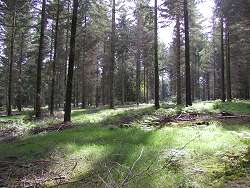
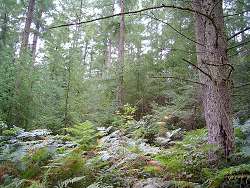
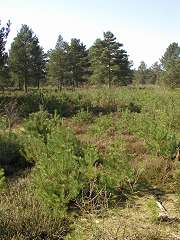
This project aims to improve understanding of the effects of stand manipulation on factors that influence the successful transformation of stands from an even-aged structure to continuous cover.
Manipulation of the stand, through the use of thinning regimes, is one of the main tools available to managers when transforming stands to continuous cover silviculture. Traditional thinning regimes are primarily designed to maintain cumulative volume production and prepare the stand for clearfelling. However, when carrying out continuous cover forestry it is important that management is adaptive. This means basing silvicultural interventions on stand level information, monitoring what happens and learning from the results. It is a simple two-stage process:
Objective information is produced on species composition, size, distribution and browsing damage on regeneration. This is useful because many forest managers:
Objective information is presented on species composition, basal area and diameter distribution of stands. This can be useful for two main reasons:
The structure of a stand is critically important when deciding how to thin it.
The software allows the forest manager to test if the diameter distribution is ‘symmetric’ (similar to a normal distribution) or ‘skewed’ as shown in the example on the right. As can be seen, a skewed distribution would have many small trees, a moderate number of medium trees and a low number of large trees, and is similar to the ‘reverse-j distribution’ much discussed as an option for managing continuous cover forests. If the stand has a symmetric diameter distribution this must be taken into account when thinning the stand, especially if the aim is to develop a structure with three or more canopy strata.
It enables forest mangers to be objective about their approach to CCF management and record the results of their interventions.
At present we have some information concerning the correct range of basal areas to use when transforming stands (see Forestry Commission Information Note 40) but have little understanding of how this will vary with site and during different stages of transformation. It is imperative that we develop this experience and share it.
Further guidance and tools and software for managing stands using continuous cover can be found on our resources page

Monitoring the Transformation of Even-aged Stands to Continuous Cover Management
Forestry Commission Information Note 45 describes the approach in detail
Software to support the transformation to Continuous Cover Forestry is available free from Forest Research.
Costs and revenues of transformation to continuous cover forestry
Modelling silvicultural options with Sitka spruce
FCPN016.pdf
(PDF-1955K)
Operational Guidance Booklet 7 – Managing Continuous Cover Forests
Report on adoption of alternative silvicultural systems in Britain