

Summary
Why do we monitor woodland arthropods?
Woodland canopy and subcanopy arthropods are highly diverse and sensitive to environmental change, making them strong indicators of woodland ecological condition. However, traditional monitoring is limited at large spatial scales and species identification is time‑consuming, costly, and often unreliable for damaged or juvenile specimens.
Survey approach
DNA metabarcoding provides a time‑ and cost‑effective alternative, enabling the simultaneous identification of large numbers of arthropods. It offers a more comprehensive and less biased measure of biodiversity than indicator species approaches and is suitable for large‑scale monitoring such as the National Forest Inventory (NFI).
What can be learned?
This project will establish baseline data on arthropod species presence, and community composition across woodland canopies. Combined with NFI metadata, it will reveal spatial and temporal trends in biodiversity to inform woodland management and policy.
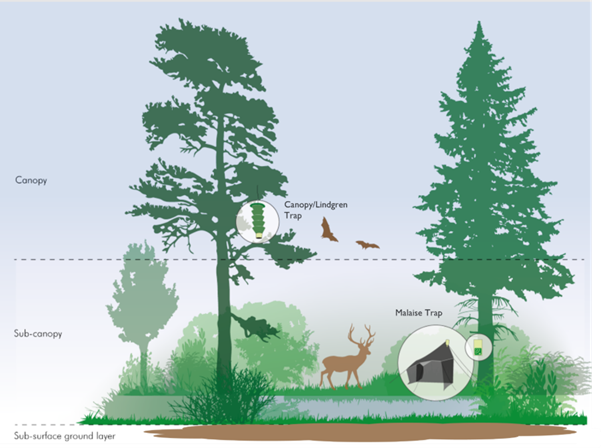
Research Objectives
This England-wide project aimed to integrate eDNA metabarcoding into the National Forest Inventory monitoring scheme as:
- a tool for routine monitoring of canopy and subcanopy arthropod communities and
- an indicator of woodland ecological condition
A particular focus was on woodland arthropod communities of the subcanopy and canopy that are known to be hyper-diverse and sensitive to environmental change.
This was achieved through:
- large-scale sampling of canopy/subcanopy arthropods using a DNA metabarcoding approach in a subset (30+) of NFI plots.
- obtaining NFI data and easy-to-capture metadata for a range of variables (e.g. woodland type, stand structure & composition, management practice) to consider alongside canopy/subcanopy arthropod species richness and functional attributes data.
Future work: Investigate the potential of integrating this dataset with wider NCEA NFI+ and concurrent NFI survey data to create a powerful spatio‑temporal resource spanning multiple above‑ and below‑ground taxa, including the Environmental Improvement Plan (EIP) and Red List species (e.g. all UK bat species). This integration could unlock new insights into how woodland structure shapes biodiversity across woodland types and landscapes, helping to drive more targeted, evidence‑led forest management to support biodiversity recovery.
Latest Update
We recently published our year 1 (2023-24) analysis ready data (ARD) in December 2025.
Further releases, alongside an interactive dashboard for data exploration, are planned for later this year so watch this space.
Funding & Partners
- Funded by the UK Government through Defra’s Natural Capital and Ecosystem Assessment programme (NCEA)
-

-