
Summary
Integrated Management of Hylobius
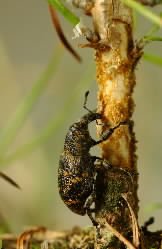
The large pine weevil, Hylobius abietis, is regarded as the most serious pest of newly planted or regenerating trees on restocking sites in the UK. Without effective management, it can destroy a very high proportion of young conifers within the first few years after planting, posing a major threat to successful forest establishment. It is therefore recommended that an integrated approach is adopted for managing this pest. As outlined in this report, such an approach begins with understanding the life cycle of Hylobius, the timing of its activity, and the extent of damage it can cause. Managers are then encouraged to consider the full range of available methods—ranging from silvicultural practices and fallow periods to physical, chemical, and biological controls—to minimise risk. A successful strategy will usually involve combining more than one technique and tailoring interventions to suit site-specific conditions, ensuring the best chance of protecting young trees while supporting sustainable forestry.
Research objectives
Our research focuses on developing sustainable alternatives to the traditional reliance on insecticides for managing forest pests. Rather than depending solely on chemical protection, we are investigating a wide range of non-chemical approaches that can be combined into effective integrated pest management strategies.
Adjustments to forest management practices—such as site preparation, harvesting methods, and timing of restocking—can help suppress populations of Hylobius and reduce the level of damage they cause to newly planted trees. Biocontrol options, for example the use of entomopathogenic fungi and nematodes, are also being explored as tools for directly reducing weevil numbers. These approaches offer targeted control that can complement silvicultural measures lowering the need for chemical use.
Alongside practical field trials, we also use monitoring and modelling tools to better understand how and when young trees are most at risk of attack. To support decision-making, we developed the Hylobius Management Support System (HMSS), a predictive tool that helps forest managers assess site-specific risk and plan control strategies with greater precision. This enables us to predict pest pressure, inform management decisions, and apply protective measures only where they are truly needed.
By building this evidence base, our aim is to reduce unnecessary pesticide use, enhance forest resilience, and provide forest managers with clear, practical guidance on how to protect new plantations while supporting sustainable forestry goals.
Status
The programme started in April 1999 and is ongoing.
Contacts
nrs_entomology@forestresearch.gov.uk
Recent Projects
2019-2023: CAN DO Novel Trapping Systems for Monitoring and Control of Hylobius abietis
Project Partners: Forest Research, Natural Resources Institute at the University of Greenwich, and Sentomol Pest Management Solutions.
The project developed a Hylobius-lure using synthetic pine compounds for use within a trap as an alternative to billets for monitoring Hylobius abietis populations. Alongside this, biological control options were trialled, with the nematode Steinernema carpocapsae and the fungus Beauveria bassiana proving the most effective. A biodegradable Biological Control Agent Delivery Device (BCADD) was designed which enabled efficient transfer of nematodes to adult weevils within hours under laboratory conditions.
2014-2017: Biological Pest Control of Insect Pests that Threaten Tree Health (BIPESCO)
Project Partners: led by Prof. Tariq M. Butt (Swansea University), Dr Glyn Jones (Fera) and Dr Roger Moore (Forest Research) with a consortium of industry partners.
This project developed environmentally friendly biocontrols based on entomopathogenic fungi and botanical compounds to manage major forestry pests. Focusing on the large pine weevil (Hylobius abietis), the research identified Metarhizium brunneum strains highly effective against adult weevils and tested plant- and fungus-derived compounds with attractant or repellent properties.
Laboratory and field trials demonstrated that combining these agents with lure-and-kill trapping systems could achieve high mortality (up to 70%) and spread fungal infection within populations, while posing little risk to non-target species. Cost–benefit analysis showed that these strategies can reduce dependence on chemical insecticides, limiting environmental impacts and supporting sustainable forest protection.
Publications
- FR_Integrated management of Hylobius abietis in UK forestry (PDF-3 MB)
This Note provides the latest guidance on the integrated pest management of the insect Hylobius abietis. In doing so it draws on some of the key findings after a 7-year programme of collaborative forest industry research on alternatives to the use of the insecticide cypermethrin for protecting trees from Hylobius damage. - Managing the Pine Weevil on Lowland Pine (PDF-1900 KB)
Forestry Commission Practice Note 14 - Resistance of young conifers to feeding damage by Pine Weevil (PDF-786 KB)
Forestry Commission Information Note 87 - The assessment of site characteristics as part of a management strategy to reduce damage by Hylobius (PDF-145 KB)
Forestry Commission Information Note 38 - Managing the threat to restocking posed by the large pine weevil, Hylobius abietis: the importance of time of felling of spruce stands (PDF-34 KB)
Forestry Commission Information Note 61 - Developments in the integrated management of pine weevil (PDF-371 KB)
Forest Research Annual Report 2003-2004 - The influence of a changing climate on development and life cycle in the pine weevil
- Acetamiprid used to prevent Hylobius abietis damaging young trees poses a very low risk of causing water contamination provided good forestry practices are followed.
- Acetamiprid, chlorantraniliprole, and in some situations the physical barriers MultiPro®or Kvaae® wax, can be alternatives to traditional synthetic pyrethroid insecticides for the protection of young conifers from damage by the large pine weevil Hylobius abietis
- Are there viable chemical and non-chemical alternatives to the use of conventional insecticides for the protection of young trees from damage by the large pine weevil Hylobius abietis in UK forestry?
Two trade journal articles have also been produced which summarise these scientific papers:-
- Willoughby, I.H. and Moore, R. (2021). Defending our trees. What’s the latest in the battle against Hylobius? Trees, summer 2021, 20-21. charteredforesters.org
- Willoughby, I.H. and Moore, R. (2020). Hylobius attack: other ways of protection. Forestry and Timber News102, 64-65. https://www.confor.org.uk/news/ftn-magazine/