In the UK, commercial timber production is dominated by conifer forests consisting primarily of just nine introduced species, with Sitka spruce making up by far the largest proportion. Diversifying the range of species planted would therefore help to reduce the extent of impacts in the event of a catastrophic failure of one of the UK’s principal timber species.
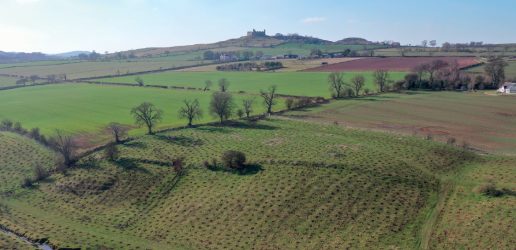
To address this, researchers at Forest Research have set up a network of nine large scale experiments across the UK, in partnership with Forestry England and Forestry and Land Scotland, to test the suitability of 17 tree species as potential alternatives for future commercial timber production. Early results from this long-term research have recently been published in Forestry: An International Journal of Forest Research.
Dr Ian Willoughby FICFor, Principal Scientist, Forest Research said: “Future climate change and the rise in damaging pests and diseases, makes our current over reliance on such a small range of species for UK commercial timber production a major risk.”
“Our trials demonstrate that five years after the 17 species were planted, many had successfully established. In fact, many were performing at least as well as standard species and exceeded expectations.”
Our trials demonstrate that five years after the 17 species were planted, many had successfully established. In fact, many were performing at least as well as standard species and exceeded expectations
The research highlighted that Douglas fir established well on most sites and may be a more versatile species than is often assumed in the UK. In the long-term, it could prove to be a productive alternative to Sitka spruce on some sites and has potential for wider use in the south and east of the country, where the climate is forecast to become significantly hotter and drier.
Maritime pine also established well and may have good potential in our future climate as a fast growing, robust species on suitable sheltered, lowland, freely draining sites.
Further monitoring of these trial sites is required to determine whether the early promise showed by many species is fulfilled in the long-term.
To find out more and read the paper in full, visit Seventeen coniferous tree species show early promise for future commercial timber production in the UK | Forestry: An International Journal of Forest Research | Oxford Academic