
Not present in the UK
Notifiable – see ‘Report a sighting’ below
Scientific name – Monochamus spp.
Common names – pine sawyer beetles, sawyer beetles, longhorn pine borers
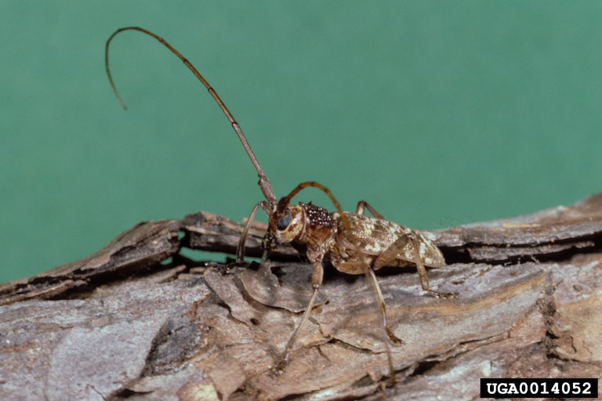
(Gerald J. Lenhard, Louisiana State University, Bugwood.org)
Pine sawyer beetles (Monochamus species) are large wood-boring beetles in the longhorn family (Cerambycidae). They are associated primarily with conifer trees, particularly pines (Pinus spp.), but some species also utilise spruce (Picea spp.), fir (Abies spp.), cedar (Cedrus spp.) and larch (Larix spp.) to a much lesser extent.
Pine sawyer beetles are generally considered secondary pests because they breed in recently dead, dying or severely stressed trees. However, they are of major plant health concern because they are the only known natural vectors of the pine wood nematode (Bursaphelenchus xylophilus), the organism responsible for pine wilt disease.
All species in the genus Monochamus are quarantine organisms, along with the pinewood nematode, under UK legislation (The Plant Health (Phytosanitary Conditions) (Amendment) (EU Exit) Regulations 2020, Schedule 1). The introduction of either pine wood nematode or its vector beetles could pose a serious threat to UK conifer forests and the timber industry.
Distribution
The genus Monochamus contains approximately 150 species distributed across North America, Europe, Asia and North Africa. Species within the genus are primarily associated with conifer forests and are native components of many forest ecosystems.
Europe:
- Monochamus galloprovincialis (European pine sawyer; currently the only confirmed vector of pine wood nematode in Europe);
Asia:
- Monochamus alternatus (Japanese pine sawyer, principal vector of pine wood nematode in Asia);
- Monochamus saltuarius (an important vector in parts of Asia)
North America:
- Monochamus carolinensis (Carolina pine sawyer)
- Monochamus scutellatus (White spotted sawyer)
While Monochamus species natively occur in parts of neighbouring Europe, the UK is free from both the beetle and from pine wood nematode. Surveillance efforts and regulations on imports focus on preventing the introduction of both the nematode and Monochamus vector beetles.
The threat
The principal plant health concern associated with Monochamus beetles is that they are the only known natural vectors of pine wood nematode (Bursaphelenchus xylophilus), the causal agent of pine wilt disease.
Most Monochamus species colonise and reproduce in weakened, storm-damaged, fire-damaged or recently felled trees and therefore cause only limited direct economic damage under normal conditions. Larvae tunnel through wood, reducing timber quality and value. For this reason, they are generally considered secondary pests.
However, adult beetles emerging from infested wood can carry nematodes within their respiratory system and under their wing covers (elytra) and transfer them to healthy trees while feeding on young shoots and twigs. After introduction, the nematodes feed within the tree, disrupting the water conductivity and transport system, leading to repaid wilting and decline. This can result in pine wilt disease, which causes rapid decline and death of susceptible pine species within one to three months. Pine wilt disease has caused extensive ecological and economic losses in Asia and continues to be a significant problem in parts of Europe.
Susceptible tree hosts
Pine sawyer beetles attack a range of conifer hosts, including:
- Pines (Pinus spp.);
- Spruces (Picea spp.);
- Firs (Abies spp.);
- Larches (Larix spp.).
Pines are generally regarded as the most important hosts, both for beetle development and for transmission of pine wood nematode. Scots pine (Pinus sylvestris), the UK’s principal native pine, is considered susceptible to pine wilt disease should the nematode become established.
Identification and symptoms
Adult beetles
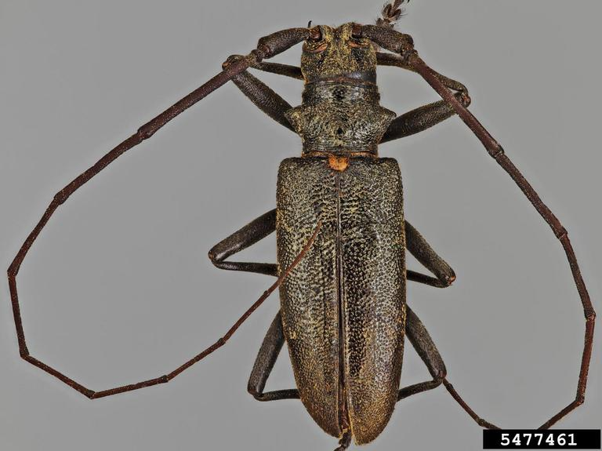
Adult pine sawyer beetles are among the largest longhorn beetles associated with conifers and are typically:
- 15 to 40 mm long, depending on the species;
- Grey, brown or black with mottled markings;
- Elongated and cylindrical in shape;
- Characterised by exceptionally long antennae, often longer than the body;
- Equipped with a distinct spine on each side of the thorax.
Males usually possess longer antennae than females.
(Steven Valley, Oregon Department of Agriculture, Bugwood.org)
Larvae
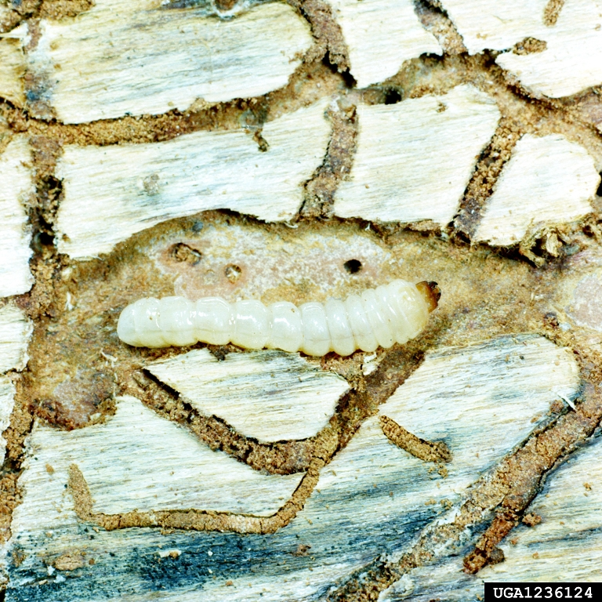
Larvae are creamy-white, legless grubs that feed beneath the bark before tunnelling into the sapwood and heartwood. Their galleries may be packed with coarse wood fibres and frass.
(Clemson University – USDA Cooperative Extension Slide Series, Bugwood.org)
Look for:
- Large oval or round adult emergence holes in the bark;
- Feeding scars on young shoots and twigs;
- Coarse wood shavings and frass around galleries;
- Larval tunnels beneath bark and within wood;
- Presence of large longhorn beetles on felled or dying conifer timber.
Trees affected solely by Monochamus beetles are usually already stressed or dying. Where pine wood nematode is present, symptoms may include rapid needle discolouration, wilting, resin reduction and tree death. Trees affected by pine wilt disease may show rapid needle bronzing within a few weeks and tree death within one-three months.
Life cycle
Female beetles lay eggs individually in notches chewed into the bark of suitable host material. After hatching, larvae feed beneath the bark before boring into the wood, where development occurs. Pupation takes place within the wood, and adults emerge through characteristic round exit holes. Depending on the species and climate, development may take one or two years.
Adults are active during the warmer months and may disperse considerable distances in search of breeding material and suitable host trees.
Spread
Natural spread occurs through adult flight.
Long-distance spread and introduction can occur through the international movement of conifer wood, including wooden pallets, crates, dunnage and other wood packaging material. Infestations may occur in untreated material, or where treatment has been ineffective and failed to eliminate the beetle’s life stages.
As immature stages develop deep within the wood, infestations can remain undetected until adult beetles emerge, sometimes months after importation. The movement of infested wood packaging is regarded as one of the principal pathways for the accidental introduction of Monochamus species and pine wood nematode into new areas.
In the UK, any introduction of pine sawyer beetles would most likely be associated with imported wood packaging material at ports, freight depots, warehouses, distribution centres, freight terminals, timber yards and other premises handling wooden pallets and crates.
Due to the close association between pine sawyer beetles and pine wood nematode, the international movement of conifer wood is also the principal pathway for the spread of the nematode.
Reporting suspected sightings
Pine sawyer beetles are not known to occur in Great Britain.
Any suspected sightings must be reported immediately to the Forestry Commission via TreeAlert.
Reports should include:
- precise location details;
- clear photographs of the beetle;
- photographs of host material and damage symptoms;
- samples or specimens, where requested by plant health inspectors;
- details of any imported wood or timber associated with the finding.
Official action and regulation
In Great Britain, Monochamus species are quarantine pests, and the introduction or spread of potentially harmful non-native species is subject to plant health legislation and official control measures where appropriate.
Please report suspected findings of Monochamus species to TreeAlert.
- Report suspected sightings of Monochamus beetles in Great Britain to us using TreeAlert. Our scientists will assess the report and pass it to the relevant (English, Welsh or Scottish) plant health authority for action if necessary.
- Report suspected sightings in Northern Ireland to the Irish plant health authorities using TreeCheck, the all-Ireland tree pest reporting tool.
Please note that TreeAlert and TreeCheck both require photographs to be uploaded. These should be clear, well-lit, close-up pictures of symptoms and/or the beetle.
Alternatively, reports can be made directly to the country plant health authority. This is the preferred option if the suspected sighting occurs in a nursery or garden centre.
The plant health authorities are:
- in England and Wales, your local office of the Plant Health & Seeds Inspectorate office (PHSI) of the Animal & Plant Health Agency (APHA), or the PHSI headquarters in Sand Hutton, York. tel: 0300 1000 313; email: planthealth.info@apha.gov.uk;
- in Scotland, the Scottish Government’s Horticulture & Marketing Unit: email: hort.marketing@gov.scot; tel: 0131 244 8923; and
- in Northern Ireland, the Department of Agriculture, Environment & Rural Affairs (DAERA) Plant Health Inspection Branch: tel: 0300 200 7847; email: planthealth@daera-ni.gov.uk.
If possible, catch any beetles you find and place them in secure containers such as sealed glass jars so that an inspector can collect them. No information is available on whether they can nip, so caution is advised when catching them.
Additional resources