
Summary
Exploring Ecoacoustics for Soil Biodiversity Monitoring
Further work within the Soil Condition and health work package under the NCEA programme was exploring the potential of ecoacoustics as a tool for monitoring soil biodiversity.
Recent research shows that the richness of the below‑ground soundscape can indicate forest ecosystem health. However, significant challenges remain, particularly in capturing the sounds of smaller invertebrates living within the leaf litter layer of the forest floor.
Developing an Acoustic Pitfall Trap
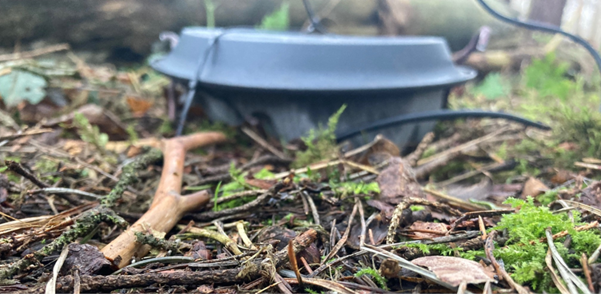
To address this, we have developed and begun testing an “acoustic pitfall trap”. This system analyses the subtle displacement noise produced by invertebrates as they move past the sensor, allowing us to infer an acoustic index of activity and gain new insights into below‑ground life.
Low‑Power Technology for Remote Monitoring
The technology uses low‑powered edge computing devices that can transmit measurements over long distances via a LoRaWAN network, making it suitable for remote and low‑impact deployment in forest environments.
Current Testing and Evaluation
We are currently testing and evaluating this approach, with the aim of improving how soil biodiversity and ecosystem health are monitored over time.
Research Objectives
To investigate use of this novel remote ecoacoustic-based methodology for forest soil biodiversity monitoring the following research questions were developed:
- Can we understand what sound made by soil fauna of various sizes and situational activity is detectable with the equipment available?
- Can we isolate “arthropod acoustics” from the recordings taken, and can we associate specific bioacoustic measurements in these recordings?
- Can we combine our measurements of soil fauna bioacoustics with a network of low-power sensors for monitoring of soil condition?
Latest Update
The methodology and technology developed by the project are awaiting further opportunities to iterate and refine the capability further. We welcome interest from partners keen to help advance this work.
Funding & Partners
- Funded by the UK Government through Defra’s Natural Capital and Ecosystem Assessment programme (NCEA)
-
-