Research
Integrated forest management of Hylobius abietis
Research Status:current

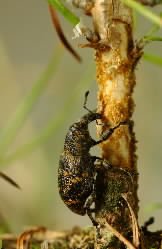
This programme is investigating the potential of Integrated Forest Management (IFM) to minimise the current emphasis on insecticide applications to protect transplants from feeding damage by Hylobius abietis the principal forestry restocking pest. The research is looking at alternatives to the traditional insecticide-based approach to plant protection and is seeking to investigate and combine other methods, including changes to forest management practices, to reduce populations and damage by Hylobius; and to predict and rationalise the ‘risk’ to transplanted trees.
The programme aims to co-ordinate, promote and synthesise all aspects of research on the large pine weevil, Hylobius abietis. The approach focuses on quantification of the effects of factors known to reduce Hylobius populations and damage and combines them in a practical way to produce compound beneficial effects. IFM as a concept parallels the Integrated crop management (ICM) approach being increasingly adopted in agriculture and the approach uses conventional Integrated Pest Management (IPM) as the core tool augmented with silvicultural and management techniques to reduce Hylobius damage.
The main objectives of the programme are to improve our understanding of the behaviour, population dynamics and migration of the weevil. Using the knowledge gained thus far a series of major field surveys were started in 2003 to develop a Hylobius Management Support System (MSS) to allow Forest Managers to make more informed decisions to improve restocking practices.
Another major part of the IFM approach is to explore the potential for utilising variation in resistance of Sitka spruce to Hylobius to improve the quality of transplants in relation to their ability to withstand feeding damage.
The ultimate aim is to combine with work on biological control of Hylobius using nematodes to reduce populations below the economic threshold for a given site.
Hylobius Management Support System
A decision support system to help foresters predict and reduce damage and costs due to large pine weevil, Hylobius abietis.
The programme started in April 1999 and is on-going.

This research is funded by the Forestry Commission Advice and scientific support for tree health programme.

Part-funding from EU Regional funds under the Interreg IIIA initiative between Wales and Ireland (Welsh European Funding Office).
Forestry Commission policy
To develop sustainable pest management strategies with the particular aim of reducing insecticides (UK Woodland Assurance Standard – UKWAS).
Research and Guidance
The large pine weevil (Hylobius abietis) is the most serious pest of newly planted or naturally regenerating woodland trees on restocking sites in the UK and Ireland. On affected sites, in the absence of protective measures, losses of replanted trees will average around 50%, but in the worst cases all trees can be killed. The need to find alternatives to the use of synthetic pyrethroid insecticides led to a collaborative research effort across the UK forest industry which investigated over 100 different approaches on 22 different trials sites.
Several lower toxicity insecticides were identified that can effectively protect trees,, as well as non-chemical approaches that may work when on-site populations are predicted to be lower.
Three scientific papers have been produced by Forest Research fully reporting on the results of these experiments, and they are freely available as follows:-
Two trade journal articles have also been produced that summarise these scientific papers:-
Willoughby, I.H. and Moore, R. (2021). Defending our trees. What’s the latest in the battle against Hylobius? Trees, summer 2021, 20-21. www.charteredforesters.org
Willoughby, I.H. and Moore, R. (2020). Hylobius attack: other ways of protection. Forestry and Timber News 102, 64-65. https://www.confor.org.uk/news/ftn-magazine/
Integrated Management of Hylobius
The latest guidance on the integrated pest management of the insect Hylobius abietis is contained in this Forest Research Report. It incorporates all the most recent research findings on alternatives to the use of conventional pesticides for protecting trees from Hylobius damage. In addition, as a separate Appendix, it summarises knowledge and guidance on the safe use of the insecticide acetamiprid, which is increasingly being used as an alternative to cypermethrin.
We are carrying out an evaluation of current practice in relation to problems arising from damage from adult Hylobius abietis (pine weevil) on newly planted trees.
Conifer site restocking questionnaire
(MS Word-240K)

Research Scientist