Research
Tree and Wood Properties
Research Status:current
We use some essential cookies to make this website work.
We’d like to set additional cookies to understand how you use forestresearch.gov.uk, remember your settings and improve our services.
We also use cookies set by other sites to help us deliver content from their services.

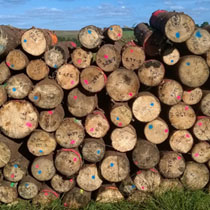
This project aims to investigate the relationships between tree growth, environment and genetics on the wood properties that are crucial to both the survival of forests and the sustainable production of a range of forest products from the domestic forest resource.
The current cycle of research was initiated in 2015 and is due to last until March 2020. We have two active Work Packages with three Work Areas in each.
The key aims of these areas of research are to develop measurement techniques that will allow us to more effectively assess and monitor the national forest resource. Plus we wish to gain further insight into how trees are shaped, in a physical and structural sense, by their environment. We are focusing on tree and wood properties that are essential for productive, yet resilient (in the sense of climate) forests, in line with current and future end uses/markets. We aim to add value to all values of the forest wood chain promoting economic growth
The main aim of these research areas is to address the changes in raw material supply to the forest product industries that can occur due to possible changes in planting and management strategies. Additionally we aim to investigate the ecosystem service of carbon sequestration provided by a range of tree species to inform the public and practitioners alike
Forestry policy
The sustainable production and utilisation of British timber is a key component of the forestry strategies of England, Scotland and Wales: research in this project will produce information and tools in support of these policy objectives.
In England the Government Forestry and Woodlands Policy Statement highlighted ‘The scope for developing new markets based around a better understanding of the value and potential of our trees, woods and forests’ and the need to “increase the amount of woodland management driven by economic activity through the sustainable harvesting of wood products”.
In Scotland, the primary objective of Scotland’s Forestry Strategy 2019–2029 is to ‘Increase the contribution of forests and woodlands to Scotland’s sustainable and inclusive economic growth’. A priority of the Strategy is to ‘Improve efficiency, productivity and developing markets’, by ‘ensuring that the wood fibre availability from Scotland’s forests and woodlands is predictable and increases over time’.
The Scottish Forest and Timber Technologies Industry Leadership Group’s Roots for Further Growth: An economic strategy for Scotland’s Forest & Timber Technologies Sector to 2030 prioritises ‘maximising the economic outputs of Scotland’s forest and fibre resource’ by ‘improving the quality and quantity of wood fibre through tree breeding research’, and also to ‘expanding markets and add value’ through research to ‘obtain the best possible technical information about wood and wood-based products’ by ‘exploring and creating new and innovative wood-based value-added products, processes and markets’.
Scotland’s Timber Development Programme focuses on four objectives:
A stated objective of the Woodlands for Wales Forest Strategy (2018) is to deliver ‘a competitive and integrated forest sector’. Key outcomes will be that ‘more timber is grown, processed and used in Wales’ and that ‘increased use is made of timber as a key renewable resource’.
Wood properties and uses of Scots pine in Britain
Assessing the stem straightness of trees
Shake in oak: an evidence review
Furthering the use of English wood products in a range of markets
Defra-funded contract aimed at developing an evidence base for understanding the behavioural, cultural, physical and economic barriers which may be limiting the use of wood products.
Wood For Good
Includes building with wood: information for architects, engineers, builders etc.
Scots pine market development report (PDF-823K)
Evaluating potential new market opportunities for Scots pine timber.
Benefits of improved Sitka spruce: volume and quality of timber (PDF-534K)
Forestry Commission Research Note 3.

Senior Scientist - Tree & Wood Properties
Cookies are files saved on your phone, tablet or computer when you visit a website.
We use cookies to store information about how you use the dwi.gov.uk website, such as the pages you visit.
Find out more about cookies on forestresearch.gov.uk
We use 3 types of cookie. You can choose which cookies you're happy for us to use.
These essential cookies do things like remember your progress through a form. They always need to be on.
We use Google Analytics to measure how you use the website so we can improve it based on user needs. Google Analytics sets cookies that store anonymised information about: how you got to the site the pages you visit on forestresearch.gov.uk and how long you spend on each page what you click on while you're visiting the site
Some forestresearch.gov.uk pages may contain content from other sites, like YouTube or Flickr, which may set their own cookies. These sites are sometimes called ‘third party’ services. This tells us how many people are seeing the content and whether it’s useful.