
Not present in the UK
Notifiable – see ‘Report a sighting’ below
Scientific name – Xylotrechus spp.
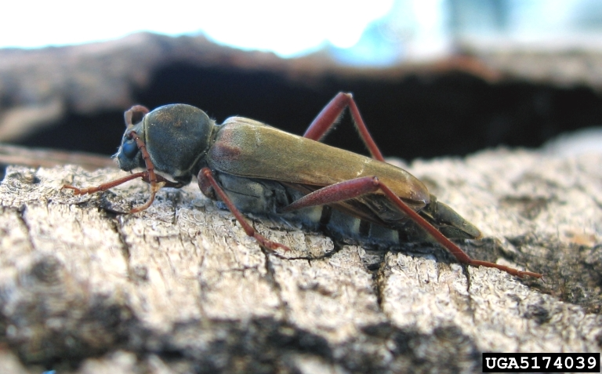
Xylotrechus altaicus (Picture: Vladimir Petko, V.N. Sukachev Institute of Forest SB RAS, Bugwood.org)
Xylotrechus is a genus of longhorn beetles (Cerambycidae) whose larvae develop within the bark and wood of living, weakened or recently dead trees. There are approximately 200 different species within the genus. Several species are of particular phytosanitary concern because they can damage forestry, amenity and orchard trees, and may be moved internationally in wood, wood products and plants for planting. All species in the genus are listed as provisional quarantine species under UK legislation (The Plant Health (Phytosanitary Conditions) (Amendment) (EU Exit) Regulations 2020, Schedule 2).
Distribution
Xylotrechus species are widely distributed across Europe, North America and Asia.
The international movement of wood, wood products and plants for planting provides opportunities for Xylotrechus species to be transported outside their native range. Larvae developing beneath bark or within wood may be difficult to detect during routine inspections.
The most significant European finding to date is Xylotrechus chinensis, which was first reported in Catalonia, Spain, in 2013. Since then, it has spread within the region and caused extensive damage to mulberry trees in urban and amenity settings. It has since been found in France and Greece.
There are currently no known established populations of Xylotrechus species in Great Britain. However, X. chinensis has established and spread in parts of southern Europe, demonstrating the capacity of some members of the genus to move beyond their native range. The concealed larval stage increases the likelihood of accidental movement in plants for planting, roundwood and wood packaging material, particularly cork bark and similar products often used in the pet trade. As a result, Xylotrechus beetles are often intercepted here.
(See ‘Official action and regulation’ below.)
The threat
Xylotrechus are wood-boring longhorn beetles whose larvae develop beneath the bark and within the wood of living, stressed, or recently dead trees. Some species attack a wide range of broadleaved hosts, while others can damage healthy trees of particular importance in forestry, urban landscapes, orchards, and amenity planting.
The greatest threat arises from species that can establish in apparently healthy trees, where larval feeding disrupts the transport of water and nutrients, weakens stems and branches, and can ultimately lead to tree decline or death. Infestations may remain undetected for several years because most of the life cycle is spent concealed within the wood.
Of particular concern are Xylotrechus chinensis, which has become invasive in parts of Europe and causes severe damage to mulberry trees, and Xylotrechus altaicus, a pest capable of attacking healthy larch. Other species, including X. namanganensis and X. grayii, have broad host ranges that could increase the risk of establishment and spread if they were to be introduced.
International trade in plants, wood, and wood products provides potential pathways for movement. Early detection is challenging because symptoms may not become obvious until adults emerge or significant internal damage has occurred.
Species profiles
Xylotrechus altaicus (pictured above)
Common name: Altai larch longhorn beetle
Hosts
Restricted to larch (Larix spp.)
Distribution
Russia, not known in the EU
Biology
A serious pest of living larch. Females lay eggs on the trunks of healthy or only slightly stressed trees. Larvae feed beneath the bark before tunnelling deeply into the wood. Development takes approximately two to three years.
Impact Unlike many Xylotrechus species that utilise weakened hosts, X. altaicus attacks healthy larch trees and is regarded as a significant forest pest within its native range
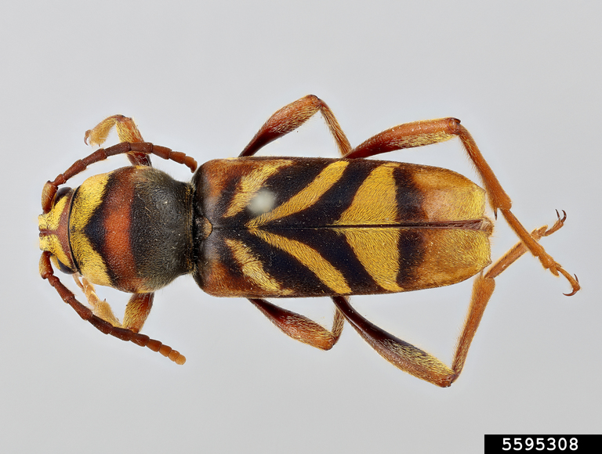
Xylotrechus chinensis (Lindsey Seastone, Museum Collections: Coleoptera, USDA APHIS PPQ, Bugwood.org)
APHIS PPQ, Bugwood.org
Xylotrechus chinensis
Common name: Tiger longhorn beetle
Hosts
Primarily mulberry (Morus spp.)
Distribution
Native to East Asia. Established invasive populations are present in parts of Europe, including Spain and other Mediterranean areas.
Biology
Females lay eggs in bark crevices on trunks and major branches. Larvae feed beneath the bark and within sapwood. Heavy infestations progressively weaken trees and can lead to mortality.
Impact
Currently the most concerning Xylotrechus species from a European biosecurity perspective. It can kill ornamental and urban mulberry trees and spreads effectively in urban environments.
Identification and symptoms
Adult beetles
Xylotrechus species are medium-sized longhorn beetles (Cerambycidae), typically 10–25 mm in length. Adults are usually black or dark brown with cream, white or yellow bands and markings across the wing cases (elytra), giving many species a wasp-like appearance. The antennae are relatively short compared with many other longhorn beetles and are generally shorter than the length of the body. Adults are often observed running rapidly over tree trunks, branches, logs and cut wood.
Key identification features include:
- Elongate, cylindrical body shape
- Distinctive transverse bands, spots or zig-zag markings on the elytra
- Wasp-mimicking colouration
- Longhorn beetle body form, with clearly visible antennae
- Adults commonly active on host trees during warm weather
Larvae
Larvae are cream-coloured, legless and cylindrical, with an enlarged thoracic region. They are found beneath bark and within the wood of infested hosts.
Exit holes
Adult emergence holes are usually round to slightly oval and occur on trunks, branches or exposed roots. These may be accompanied by accumulations of frass (wood dust) and exposed larval galleries beneath loosened bark.
Symptoms and Damage
Most of the feeding damage is caused by the larval stage, which feeds beneath the bark and within the wood. Because larvae are concealed, infestations may remain unnoticed until significant damage has occurred.
External symptoms
Symptoms may include:
- Small piles of frass (sawdust-like material) on bark, in bark crevices or around the base of trees
- Cracks, splits or abnormalities in bark
- Round or oval adult emergence holes
- Sap flow or staining around larval feeding sites
- Dieback of individual branches or sections of the crown
Internal symptoms
Removal of bark may reveal:
- Larval galleries beneath the bark
- Tunnels extending into sapwood and heartwood
- Pupal chambers within the wood
- Extensive boring that weakens the structural integrity of stems and branches
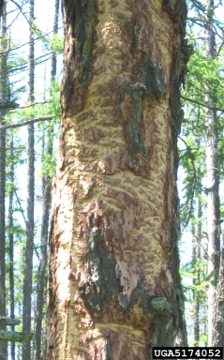
Damaged larch caused by larval feeding of X. altaicus (Vladimir Petko, V.N. Sukachev Institute of Forest SB RAS, Bugwood.org)
Advanced infestations
Heavily infested trees may show:
- Progressive crown thinning
- Reduced vigour and growth
- Branch breakage
- Stem weakness
- Tree mortality in susceptible hosts or after repeated attack
Confusion with other pests
Symptoms can resemble those caused by other wood-boring beetles, particularly other longhorn beetles and wood wasps (Siricidae). In particular, many Xylotrechus species may be mistaken for the native wasp beetle, Clytus arietis, a perfectly harmless native species. Clytus arietis are black-and-yellow longhorn beetles that mimic wasps and are often seen on trunks, logs, and flowers during summer. Careful examination of elytral markings, body shape, host association, and geographic origin is used to identify between Xylotrechus and Clytus species.
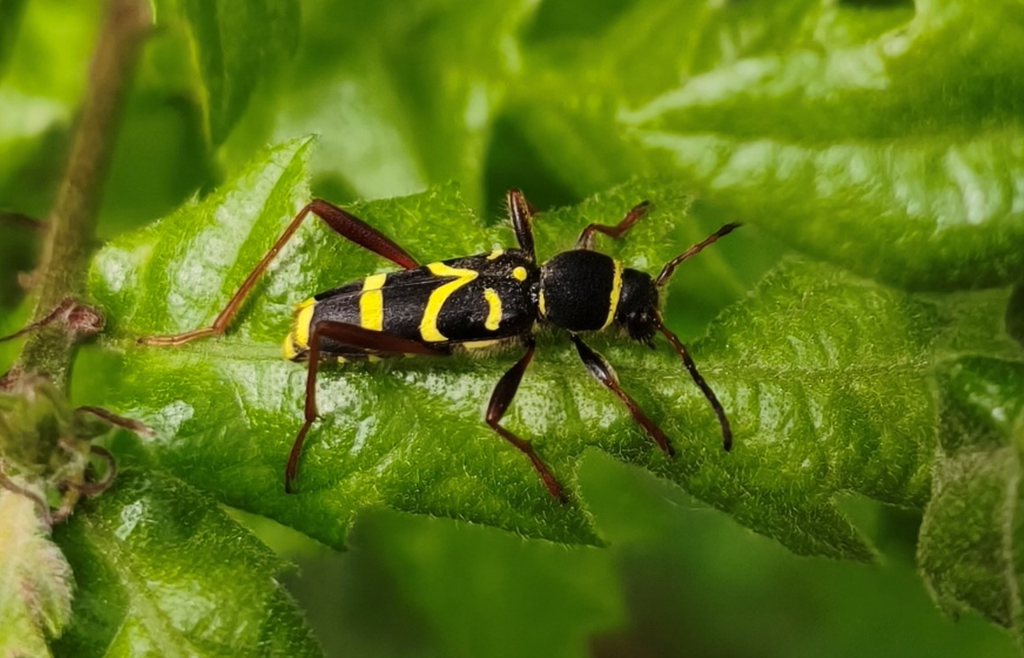
Clytus arietis (Melissa Bushell)
Report a sighting
Any suspected sightings must be reported immediately to the Forestry Commission via TreeAlert.
Reports should include:
- Precise location details;
- Photographs of adults, larvae or exit holes;
- Details of the host plant or details of the origin of the wood material;
- Information on the location and extent of damage;
- Samples or specimens, where requested by plant health inspectors.
Early detection is important because infestations may remain hidden within wood for one or more years before external symptoms become apparent.
Official action and regulation
The Xylotrechus species covered in this webpage are not known to be established in Great Britain, although members of this genus are regularly intercepted from wood materials and cork-bark products.
In Great Britain, Xylotrechus species are treated as provisional quarantine pests, and the introduction or spread of potentially harmful non-native species is subject to plant health legislation and official control measures where appropriate.
Please report suspected findings of Xylotrechus species to TreeAlert.
- Report suspected sightings of Xylotrechus beetles in Great Britain to us using TreeAlert. Our scientists will assess the report and pass it to the relevant (English, Welsh or Scottish) plant health authority for action if necessary.
- Report suspected sightings in Northern Ireland to the Irish plant health authorities using TreeCheck, the all-Ireland tree pest reporting tool.
Please note that TreeAlert and TreeCheck both require photographs to be uploaded. These should be clear, well-lit, close-up pictures of symptoms and/or the beetle.
Alternatively, reports can be made directly to the country plant health authority. This is the preferred option if the suspected sighting occurs in a nursery or garden centre.
The plant health authorities are:
- in England and Wales, your local office of the Plant Health & Seeds Inspectorate office (PHSI) of the Animal & Plant Health Agency (APHA), or the PHSI headquarters in Sand Hutton, York. tel: 0300 1000 313; email: planthealth.info@apha.gov.uk;
- in Scotland, the Scottish Government’s Horticulture & Marketing Unit: email: hort.marketing@gov.scot; tel: 0131 244 8923; and
- in Northern Ireland, the Department of Agriculture, Environment & Rural Affairs (DAERA) Plant Health Inspection Branch: tel: 0300 200 7847; email: planthealth@daera-ni.gov.uk.
If possible, catch any beetles you find and place them in secure containers such as sealed glass jars so that an inspector can collect them. No information is available on whether they can nip, so caution is advised when catching them.