
Present in UK (I. typographus only)
Notifiable – see ‘Report a sighting’ below
Scientific names – Ips typographus, I. duplicatus and I. amitinus
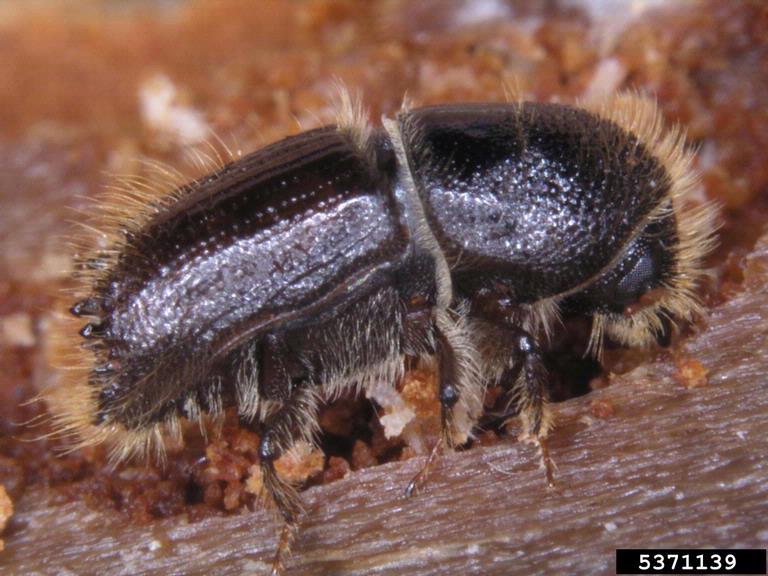
Ips typographus adult (Picture: Gyorgy Csoka, Hungary FRI, Bugwood.org)
Engraver beetles in the genus Ips are destructive pests of coniferous trees, particularly spruce and pine trees (trees in the Picea and Pinus genera respectively). However, they can also inhabit coniferous trees in other genera such as larches and firs (Larix and Abies spp.).
Three European species of Ips beetles are of particular concern to the UK. They are:
- the larger eight-toothed European spruce bark beetle (Ips typographus);
- the double spined spruce bark beetle (I. duplicatus); and
- the small spruce bark beetle (I. amitinus).
The three species look very similar to one another and have very similar behaviours, effects and life-cycles. In regions where two or all three species are established, they often co-exist on the same trees.
Their scientific names are more frequently used and easier to remember than their common names, and sometimes the same or very similar common names are used for two or more species, causing confusion, so this page uses their scientific names.
Distribution
I. typographus is present in spruce trees, especially Norway spruce (Picea abies), in most of continental Europe. Its range extends from Russia and Scandinavia in the north to Italy, Slovenia and Bosnia-Herzegovina in the south, and France, Belgium and The Netherlands in the west. It is also present in China, Japan, North and South Korea, and Tajikistan.
Only one outbreak (breeding population) has ever been discovered in the United Kingdom, in a woodland in Kent, England, in December 2018. It is currently subject to statutory eradication action. (See ‘Regulation’ and ‘Official action’ below.)
I. duplicatus is widespread across the northern part of the Eurasian landmass from Scandinavia to China and Japan. It has been observed spreading southwards in Europe since the 1990s, and very high populations have been recorded in the Czech Republic, Slovakia, Poland and Romania. It is considered to be invasive and a quarantine pest in Slovakia.
I. amitinus is present in most continental European countries from the Mediterranean Sea to Russia and Scandinavia, as far east as Bulgaria, Romania, Ukraine and western Siberia. It has also been reported in Tunisia, North Africa. It has not been reported from Spain, Portugal and Corsica.
Live adults of I. typographus and I. amitinus have occasionally been trapped in the UK during routine monitoring at sites such as sawmills and ports handling imported wood. However, no signs of an outbreak have ever been found in follow-up surveys at or near these sites.
Susceptible species
I. typographus: Most species of spruce are susceptible to this pest, and the widespread presence of Norway spruce in continental Europe means it is the most affected species. It has, however, also been observed on firs, pines and larches.
I. duplicatus: Siberian spruce (Picea obovata) is this pest’s main host tree in the European and Siberian taiga. In Sakhalin, Russia, the main host tree is Yeddo spruce (Picea jezoensis); in China it is Korean spruce (Picea koraiensis); and in Europe it is Norway spruce.
Infestations have also been observed on Scots pine (Pinus sylvestris), arolla pine (Pinus cembra), Siberian stone pine (Pinus sibiricus), Eastern white pine (Pinus strobus) and the Pinus cembra var. sibirica hybrid. It has been observed on larches in Siberia.
I. duplicatus only attacks standing trees: it has not been known to inhabit trees and logs lying on the ground.
I. amitinus’s preferred host species are Norway spruce and Scots pine, and in 2019 it was also observed to be abundant on Siberian stone pine in western Siberia. However, it can also live on several other species of pine and spruce, as well as larches and firs.
The threat
Although Ips engraver beetles are mainly ‘secondary’ pests’, preferring dead, stressed or weakened trees. They are detritivores, which feed on and break down dead plant matter, returning nutrients to the ecosystem. Healthy trees usually fend them off by producing insecticidal and fungicidal compounds that kill, injure or repel attacking insects. However, under the right environmental conditions the beetles’ numbers can increase enough to result in attacks on healthy trees.
If they were introduced to the UK and left uncontrolled, they could cause significant damage to our pine and spruce-based forestry and timber industries. This is especially so where pathogenic (disease-causing) fungi are present, because the beetles can spread them. Blue-stain fungi (e.g., Endoconidiophora polonica or Ophiostoma polonicus) in particularare associated with I. typographus.
Sitka spruce (Picea sitchensis) is widely grown for the softwood timber market in the UK, especially in western and northern regions, where it is well suited to the wetter climate. There is little practical experience of the beetles on Sitka spruce, which is native to North America. However, we believe it is reasonable to presume that it would be at least as susceptible to damage by these beetles as its European relatives.
Hundreds of millions of pounds of investment and thousands of jobs in nurseries, forests, timber transport, sawmills and other wood-using industries depend on Sitka spruce and Scots pine to some extent. Norway spruce is also grown here, although the area planted with it has been declining as many growers prefer to switch to other species, including Sitka spruce, when replanting harvested sites.
The other significant concern in the UK is the threat the beetles would pose to our Scots pine forests. Scots pine is the UK’s only native pine species, and it is an important species in the softwood timber production industry, particularly in drier regions of Scotland and England.
Scots pine forests – and especially forests of the ecologically important Caledonian pine variety in Scotland – are also important to the ecology, biodiversity and landscape character of their localities. They are a preferred habitat of several vulnerable species, including capercaillie (Tetrao urogallus), red squirrels (Sciurus vulgaris), pine martens (Martes martes), Scottish wood ants (Formica aquilonia), Rannoch looper butterflies (Macaria brunneata), crested tits (Lophophanes cristatus), Scottish crossbills (Loxia scotica) and Scottish wildcats (Felis silvestris silvestris).
Their attractive, open character and the wildlife they support also make them a significant resource for the tourism and recreation sectors. Many host walking, cycling and horse-riding trails, wildlife-watching facilities, camping and caravan sites and other receational facilities.
Our pine and spruce forests are already affected by several pests and diseases, including conifer root and butt rot (Heterobasidion annosum), Dothistroma needle blight (Dothistroma septosporum), great spruce bark beetle (Dendroctonus micans), large pine weevil (Hylobius abietis), and pine-tree lappet moth (Dendrolimus pini). The introduction of any more pests or diseases affecting pine and spruce trees could risk pushing them into decline, and putting at risk the benefits mentioned above.
Identification and symptoms
Ips engraver beetles are often associated with windblown, damaged and recently felled trees, where they build up numbers before moving on to attack adjacent live trees. Inspection of trees in this category should therefore be a priority.
Look also for individual dead trees, or groups of them. The latter arise when the beetles “mass attack” trees, overcoming the trees’ usual chemical defences by a combination of large numbers and blue-stain fungus. This phase can lead to extensive tree deaths.
Affected trees develop discoloured crowns: the needles become lighter in colour, form mats, and often fall to the ground.
Light-brown frass (dust and droppings made by the boring larvae) can be found on the bark, and on the bases of the stems (trunks) of standing trees.
Woodpecker activity can be a sign of Ips presence, because the birds break off the bark of affected trunks to look for larvae underneath.
Inspection of the bark, and of the wood under the bark, should reveal a linear gallery system where the females lay their eggs.
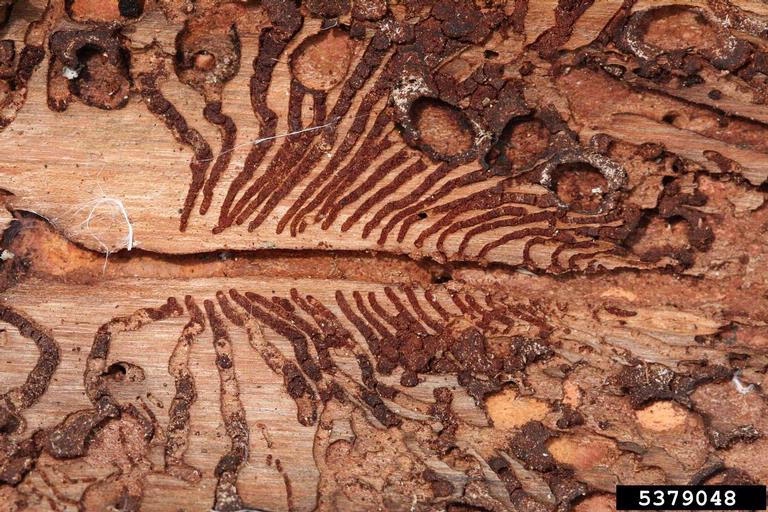
(Picture: Milan Zubrik, FRI Slovakia, Bugwood.org)
Larval galleries radiate outward from these linear galleries, as pictured above, becoming wider as the larvae grow as they burrow along. This gallery pattern pictured is unique to I. typographus, and can therefore be relied upon as an indicator of its presence. However, the pattern might not always be as easy to discern as the above description and picture imply, so any variation should be treated with suspicion and investigated further.
Although not of the same ‘design’, the galleries made by I. duplicatus and I. amitinus are of a similar nature. Those of I. amitinus extend vertically from a nuptial (mating) chamber, with four to seven irregular and wavy maternal galleries.
Ips beetles are known as ‘engraver’ beetles because of the ‘engraved’ appearance of the galleries, as in the picture below. This characteristic also gave rise to the name ‘Ips typographus’, typography being the art of engraving.
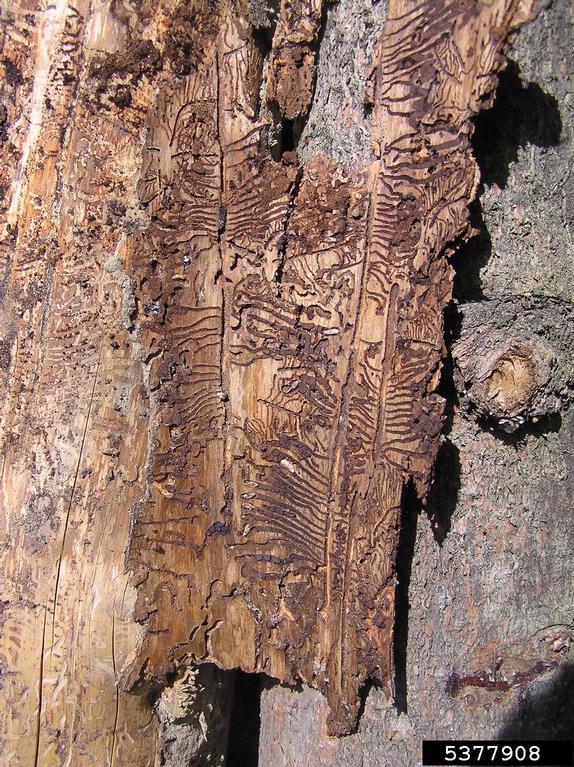
(Picture: Milan Zubrik, FRI Slovakia, Bugwood.org)
Adult beetles hibernate over winter under the bark of trees and logs, and in leaf litter. They then re-emerge in spring, when the temperature rises above 20°C.
All beetles in the Ips genus have distinctive spines on their posterior end.
Note that they can be confused with the great spruce bark beetle (Dendroctonus micans), another pest of spruce trees.
This Forestry Commission symptoms field guide provides further help with identification.
Report a sighting
The discovery of the I. typographus outbreak in Kent highlighted the risk of accidental introductions and subsequent spread, and the need for us in the UK to be constantly vigilant for this pest. Suspected sightings must be reported immediately to the plant health authorities.
- Report suspected sightings in Great Britain to us using TreeAlert.
- Report suspected sightings in Northern Ireland to the Irish forestry authorities using TreeCheck, the all-Ireland tree pest reporting tool.
Please note that TreeAlert and TreeCheck both require photographs to be uploaded. These should be clear, well-lit, close-up pictures of symptoms, and/or the beetles themselves.
Alternatively, suspected sightings can be made directly to the relevant plant health authority. This is the preferred route for suspected sightings made on trade premises, such as nurseries, garden centre, ports and wood-processing mills.
- In England and Wales, contact your local APHA Plant Health & Seeds Inspector, or the PHSI headquarters in York: tel: 0300 1000 313; e-mail: planthealth.info@apha.gov.uk; web: www.gov.uk/plant-health-controls.
- In Scotland, contact the Scottish Government’s Horticulture & Marketing Unit: e-mail: hort.marketing@gov.scot; tel: 0131 244 8923; web: www.gov.scot/PlantHealth/PlantDiseases.
- In Northern Ireland, contact the DAERA Plant Health Inspection Branch: tel: 0300 200 7847; e-mail: planthealth@daera-ni.gov.uk; web: www.daera-ni.gov.uk/topics/plant-and-tree-health/about-plant-and-tree-health.
In all cases, provide precise details of the location and, if possible, clear photographs of the pest and/or symptoms.
Spread
These species can expand their ranges naturally, assisted by their ability to detect suitable host material, especially dead or stressed and weakened trees. This is especially so after environmentally disruptive events which kill or stress large numbers of trees, such as storms, droughts and severe fungal attacks. The resulting abundance of new host material can lead to rapid population increases, which can then impel the beetles to attack healthy trees nearby.
They can also be spread in movements of infested logs and firewood in trade.
Biology and life cycle
Bark beetles reproduce in the inner bark and the living and dead phloem tissues of trees. The phloem cells conduct nutrients from the leaves down other parts of the tree. The beetles’ activity, and that of any blue-stain fungi they introduce, can disrupt the phloem and hasten the tree’s decline and death.
Adult beetles hibernate in forest litter and host trees when environmental conditions are not favorable for reproduction.
When conditions are right, they travel to a suitable host tree. I. typographus beetles can travel up to half a mile for this purpose. They burrow through the weakened bark to build the galleries, or tunnels, where they mate and lay eggs. They release pheromones to attract more of their species to the tree. They can migrate to another suitable host tree two to five weeks later, and repeat the process. Once the larvae hatch, they feed and pupate under the bark. Up to three generations are produced per year.
Bark beetles communicate with one another using semiochemicals, which are compounds that carry messages. They appear to be able not only to detect olfactory signals directly from other bark beetles, but also some compounds from trees.
It is also possible that beetles are attracted to the pheromone ipslure, and to to ethanol, which is a by-product of microbial growth in dead woody tissues.
Bark beetles can form a symbiotic relationship with certain Ophiostomatales fungi. These phloem-feeding bark beetles use phloem-infesting fungi as an addition to their diet.
Regulation
I. typographus, I. duplicatus and I. amitinus are endemic to mainland Europe, but until 2018 none of them had been known to be present in the UK. We therefore have European Union ‘protected zone’ status to protect us from their introduction of the beetle, which will be converted to a Great Britain form of protection from 1 January 2021.
See the Forestry Commission’s publication Regulated European Union (EU) trade and plant passporting requirements for an explanation of the controls on moving conifer material from EU member states into the UK.
Management and control
There is debate in affected countries about the best methods of preventing outbreaks of Ips engraver beetles, or of minimising their impacts if they do occur. Some authorities suggest that outbreaks be allowed to run their course, even at the expense of most of the forest. Others, including the timber industry, prefer intervention.
Some experts argue that salvage logging tends to have a worse impact on forest vegetation than the beetle outbreak itself. A study of the effects of forestry interventions on the herb and moss layers of infested mountain spruce forests suggest that without intervention the forests do eventually recover. Salvage logging also had negative effects on the composition of species, delaying recovery.
Several methods have been proposed to prevent the start of beetle outbreaks. Some involve setting “trap trees” at the beginning of each reproductive cycle. This should be done in March, May and in late June or early July. The trap trees should be debarked when distinct larval galleries with small larvae are found.
Another method is clearcutting, removing groups of trees at the first signs of infestation. Pheromone traps can also be used.
Removal of attractive material, such as logs with bark, weakened trees, and wind-thrown trees, might help to prevent outbreaks.
Official action
The Forestry Commission’s contingency plan sets out the steps that would be taken – and which were taken in the Kent event – if an outbreak of any of these specieswere discovered in Great Britain.
I. typographus is subject to the Plant Health (Ips typographus) (England) Order 2019, which gives the Forestry Commissioners powers to take steps to prevent spread of the pest from outbreak sites. More-detailed information about these powers and restrictions, and the actions taken in Kent, is available on the UK Government website.
Covid-19
In light of the COVID-19 pandemic, Defra and the Forestry Commission considered whether work to eradicate the Ips typographus outbreak in Kent should continue. They reviewed critical functions, and concluded that the work should continue because this is a quarantine pest. They are keeping official Covid-19 guidance under review and, if the situation changes, plans might be adjusted.
Origins and background
Ips typographus: There is little available information about the origins of I. duplicatus except that is native to Europe and Asia, especially regions where its main host, Norway spruce, naturally occurs.
Ips duplicatus is native to northern Europe and Siberia, but has been spreading southwards in Europe. It used to be common in southern Finland, but its population there has been declining as a result of competition from Ips amitinus, which has been spreading northwards from central Europe. The trend is different in Central Europe, through which I. duplicatus has been spreading, particularly in southern Poland, northern Slovakia, north-eastern Czech Republic, and Romania.
Ips amitinus: Small spruce bark beetle’s native range is thought to be in Central Europe, but its range has been expanding, particularly northwards, since the early 20th Century. The rate of spread has appeared to accelerate since the 1990s, possibly aided by the warming climate and the increase in the international trade in timber and plants.
In continental Europe, I. amitinus usually attacks trees in association with other, related species such as I. typographus and I. duplicatus. However, we believe it is prudent to presume that it would pose a threat to our conifer forests even if it did enter the UK unaccompanied by either of the other species.