
Background
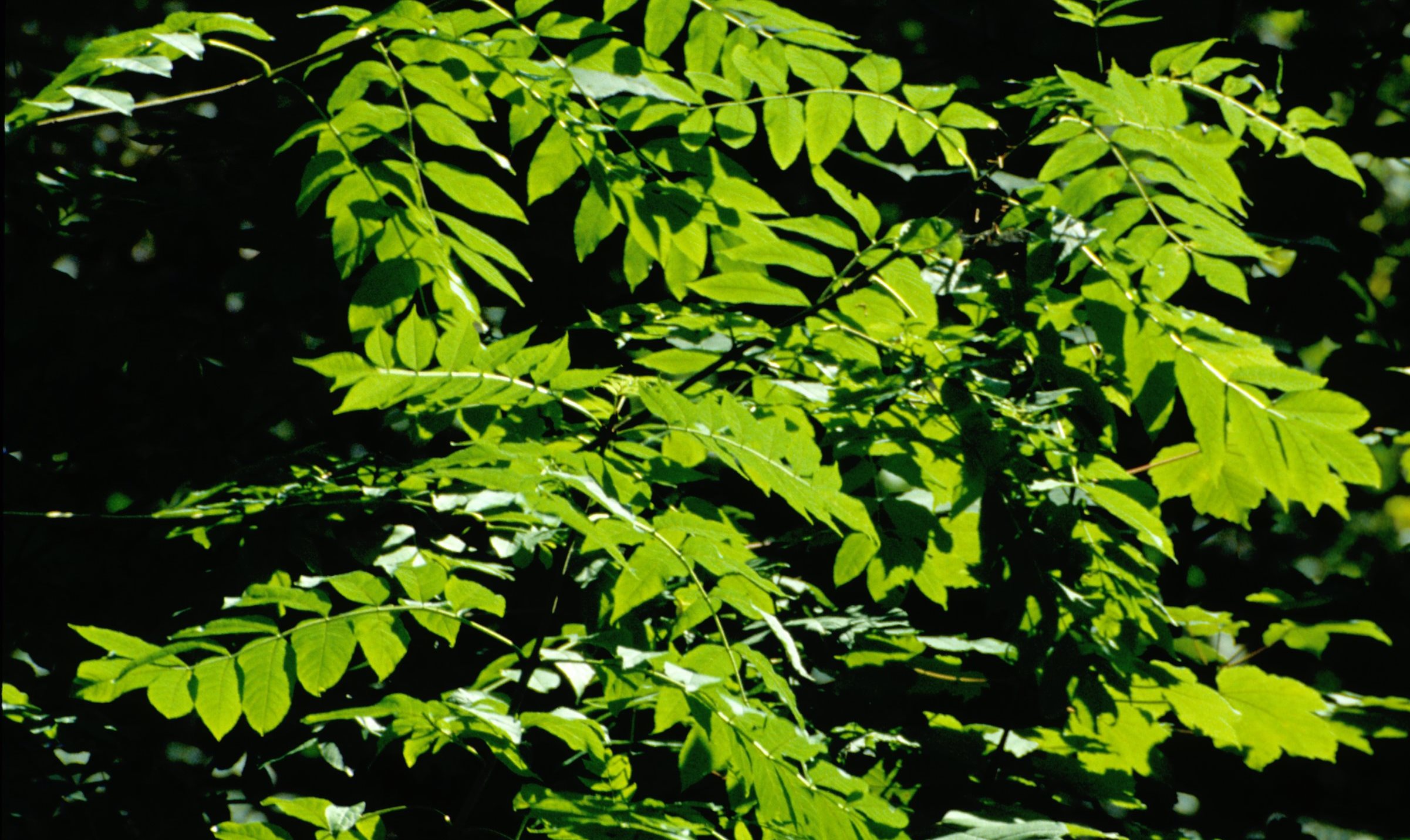
So far no individual ash trees have been found which have been scientifically proven to be totally resistant to chalara ash dieback, caused by the Hymenoscyphus fraxineus fungus. A totally resistant tree would show no symptoms at all despite being exposed to enough spores of the fungus over enough time to show symptoms if it were susceptible to infection.
However, some Asian species of ash are little affected by contact with the fungus, having co-evolved with it over thousands of years. They typically incur only minor symptoms in the leaves and twigs, while the trees remain otherwise healthy. Such trees are described as being disease tolerant.
Research and evidence in continental Europe, and increasingly so in the United Kingdom, show that a few individuals of common ash (Fraxinus excelsior) species also consistently show low levels of infection. These trees could be used to found a chalara-tolerant breeding population for the future.
In addition, there is the possibility that some ash trees will become diseased, then recover, and these trees, too, are valuable for research into the factors that enable them to recover.
Meanwhile, other British partners in the Nornex consortium of research institutions studying ash trees' tolerance to chalara ash dieback believe they have identified some genetic markers in ash trees' DNA which are associated with tolerance. This further raises hopes that it will be possible to breed tolerant ash for the future. Knowing the genetic markers for tolerance means that scientists do not have to wait until a tree has survived exposure to the fungus for several years before being confident that it is tolerant – if it's got the markers, it is probably tolerant.
Tolerance is heritable, that is, it can be passed down the generations, and it appears to be due to a suite of genes rather than a single gene. This is important, because the tolerance is less likely to break down due to genetic changes in the H. fraxineus fungus if it is based on a combination of several genes in ash.
It should therefore be possible to breed some degree of tolerance into ash populations, although it will take several years before this will provide planting stock for the market.
How woodland owners can help
Woodland owners and managers can help our scientists progress this work in two ways.
The first is by not felling any living ash trees, whether infected or not, unless felling is necessary for public safety or timber production reasons.
The second is by monitoring their ash trees’ health over the coming years, and reporting to the Living Ash Project any which appear to be little affected after several years' heavy exposure to the fungus, or which become diseased, then recover. The Living Ash Project is a partnership between us and the Future Trees Trust.
Please only report apparently tolerant trees which are:
- standing in a woodland: in other words, please do not report trees in hedgerows, gardens or parks etc, because these trees are more likely to be healthy simply because they have escaped contact with enough spores of the fungus to trigger infection; and
- within a few tens of metres of several or many other ash trees with heavy infection, (that is, not just one or two infected trees, and not infected trees which are 100 metres or more away. This is so that there can no doubt that the apparently tolerant tree has indeed had contact with enough spores to have caused disease if it were susceptible).
When submitting a report of an apparently tolerant ash tree, please include:
- a clear, well lit, in-focus photograph or photographs of the tree, including clear evidence that the tree is an ash and not some other species, e.g. a close-up picture of the leaves;
- a photograph or photographs of nearby ash trees with heavy infection, again clearly showing, if possible, that they are ash trees;
- an indication or estimate of how long the heavily infected trees have been infected – this should be some years;
- the name and address of the property where it is located – please seek the owner’s permission if you are not the owner;
- a 12-character Ordnance Survey grid reference, e.g. AB 12345 67890, of the site where the tree is standing. You can use this free-to-use grid reference finder to obtain the reference;
- your contact details, including a daytime contact telephone number where we can reach you with any queries; and
- your written permission to use and share your contact details (address, telephone number, email address etc) with partner organisations in the Living Ash Project only, solely for the purposes of scientific research into chalara ash dieback. Forest Research and the Future Trees Trust will keep your contact details secure, and we will not use your details for any other purposes or share them with any other organisations without your express prior written permission.
Please send reports of apparently tolerant trees to:
- jo.clark@futuretrees.org; or
- Future Trees Trust, 3 Queen’s Square, Chalford Hill, Stroud, GL6 8EG.
By helping us in this way, you and your trees could play a key role in ensuring that future generations will continue to enjoy the sight of ash trees in the landscape and all the environmental, social and economic benefits they provide.
For a summary of our research into chalara tolerance so far, see our main chalara ash dieback page.