Summary
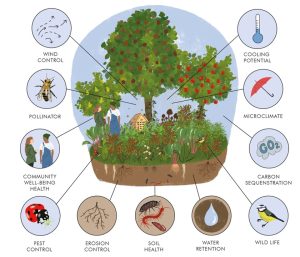
This research explores the concept of food forests (FF) as a food production system in temperate climates with a particular focus on England and Wales. It seeks to understand how FF in England and Wales are defined, how many currently exist, the different forms they take, and what potential they hold for wider adoption.
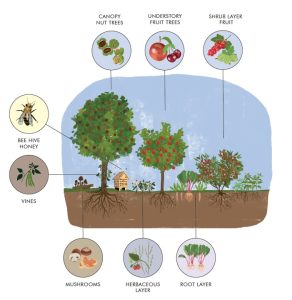
FF are multi-functional, predominantly perennial-based agroforestry systems that produce food while providing ecosystem services such as water regulation, nutrient cycling and biodiversity enhancement. Designed to mimic the structural and ecological complexity of young or mid-succession stage natural forests, they are characterised by canopy trees and multiple vertical layers, such as sub-canopy trees, shrubs, herbaceous plants, climbers and root crops.
Future work includes exploring the scope to up-scale FF systems. This can be by creating more sites or increasing the size of a FF at a single site. The concept of FF aligns closely with several key national priorities, including strengthening food security, broadening the diversity of UK-grown foods, increased ecosystem services (ES) provisioning, such as pollination support and improved soil health.
Research Objectives
Current:
- Design, establish, and implement a food forest experimental trial in the UK to evaluate the performance of different food forest systems over time.
- To develop a monitoring and evaluation framework for food forests in the UK, including the identification and standardisation of measures and monitoring approaches that effectively capture ecosystem service delivery for long-term application.
- Generate robust UK-based evidence on ecosystem service delivery in food forest systems through empirical data collection.
*** We are seeking expressions of interest from farmers, growers or landowners who would consider participating in setting up a commercial-scale food forest trial and are able to commit a portion of their land to it for a minimum period of 10 years. Forest Research and members of the Permaculture Association with experience in Food Forest design will co-design trials with you. We also want to hear from practitioners who have trialled their own large scale food forest plantings. *** Please drop us a line at foodforests@forestresearch.gov.uk
Completed (publication in prep):
- Define and characterise food forests in England and Wales
- Assess the social and economic costs, opportunities, and challenges associated with establishing food forests at scale.
- Evaluate the expected economic returns of food forests.
Findings and Recommendations
- FF field is still a growing field, with lots of different terminology and definitions.
- Terminology matters, as some terms are associated with specific FF types and may affect practitioner acceptance of universal definitions.
- Most food forests identified were small, private, and generally not economically motivated. A few commercial FF sites were identified in England and Wales.
- Motivations differed by FF type (private, community, commercial) and included biodiversity enhancement, food production, crop diversity/resilience, and wellbeing benefits.
- FF design is complex and requires knowledge of species interactions and life cycles.
- Suggested mechanisms to support scaling included planning policy, use of public-sector land, tailored funding, exemplar site networks, and increased awareness and acceptability of FF systems.
- Key needs highlighted included practitioner networks, peer-to-peer learning, financial support, access to materials, and stronger evidence bases.
- Long-term data are needed on edible yield, soil health, biodiversity, and wildlife support.
General Content
FF Definition Food forests are multi-functional, predominantly perennial-based agroforestry systems that produce food while providing ecosystem services such as water regulation, nutrient cycling and biodiversity enhancement. Designed to mimic the structural and ecological complexity of young or mid-succession stage natural forests, they are characterised by canopy trees and multiple vertical layers, such as sub-canopy trees, shrubs, herbaceous plants, climbers and root crops.