
Introduction
Reinforcements and reintroductions can serve as important tools for species recovery, but best practice dictates that the progression of such projects should be subject to feasibility studies. This research serves as an initial social feasibility study for the potential reintroduction of European wildcats (Felis silvestris) into Kielder Forest, Northumberland. The research comprised three components: a stakeholder mapping exercise, key stakeholder interviews with 26 individuals (representing 23 organisations), and a public attitudes survey completed by 450 local residents. Through these activities, we sought to assess: knowledge of the European wildcat, support for and perceived impacts of a reintroduction, and preferences for governance should the reintroduction progress.
With the European wildcat thought to have been absent from the area for over 150 years, many of the area’s residents are now understandably unfamiliar with the species.
This study provides sound justification for continued consideration of a European wildcat reintroduction into Kielder Forest. However, additional research and engagement will be needed to provide the assurances sought by different interest groups and the local population.
Knowledge of European wildcats
We assessed knowledge of European wildcats through questions about the species’ physical characteristics, behaviour, and conservation status.
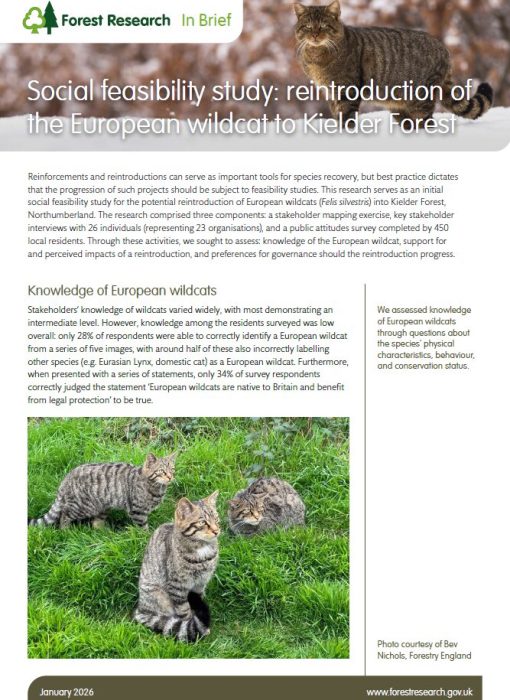
Stakeholders’ knowledge of wildcats varied widely, with most demonstrating an intermediate level. However, knowledge among the residents surveyed was low overall: only 28% of respondents were able to correctly identify a European wildcat from a series of five images, with around half of these also incorrectly labelling other species (e.g. Eurasian Lynx, domestic cat) as a European wildcat. Furthermore, when presented with a series of statements, only 34% of survey respondents correctly judged the statement ‘European wildcats are native to Britain and benefit from legal protection’ to be true.
Support for reintroduction
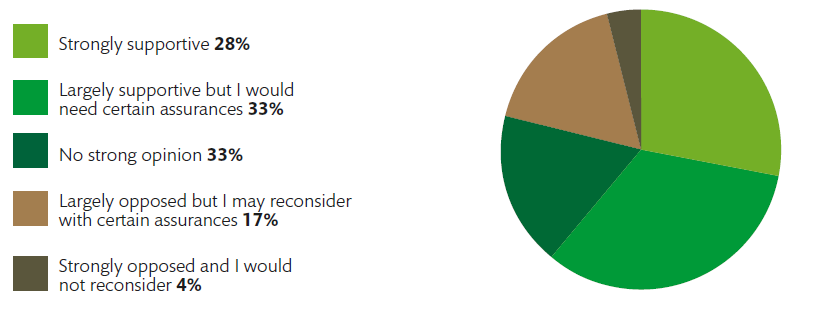
Despite some perceived risks, the vast majority of the 26 stakeholders interviewed described themselves as either ‘neutral’ (n = 9), ‘supportive’ (n = 6), or ‘strongly supportive’ (n = 6) of European wildcats being reintroduced to Kielder Forest, with only three individuals ‘opposed’ and none ‘strongly opposed’. Two interviewees opted not to answer without having more information. Survey respondents were similarly positive.
Support for a European wildcat reintroduction into Kielder Forest, derived from a survey of 450 local residents in January–April 2024.
Perceived risks and benefits (unranked) of a European wildcat reintroduction
These perceived risks and benefits were derived from interviews (n = 26) and survey responses (n = 450, data collected January–April 2024).
Perceived risks
- Threats to wildcats (e.g. unsuitable habitat, insufficient prey, roads, persecution, and hybridisation with domestic/feral cats)
- Predation of rare and recovering species (e.g. red squirrel, pine marten, water vole, and various ground nesting birds)
- Predation of lambs
- Additional restrictions for forest harvesting operations.
Perceived benefits
- Increased biodiversity
- Restoration of the ecosystem to a more natural state
- Existence value (i.e. positive impact of knowing wildcats would be present)
- Economic benefits stemming from ecotourism.
Going forward
To address the concerns of different stakeholder groups and the local public, we recommend:
- further research into the area’s suitability for wildcats (e.g. habitat
and prey availability) - activities designed to improve knowledge of the species
- ongoing engagement with key stakeholders and local residents,
including opportunities to discuss and shape any future management
(e.g. monitoring and mitigation plans).
Ideally, these activities should be advanced by an individual already embedded in the local community, rather than instating an expert from further afield.