
Introduction
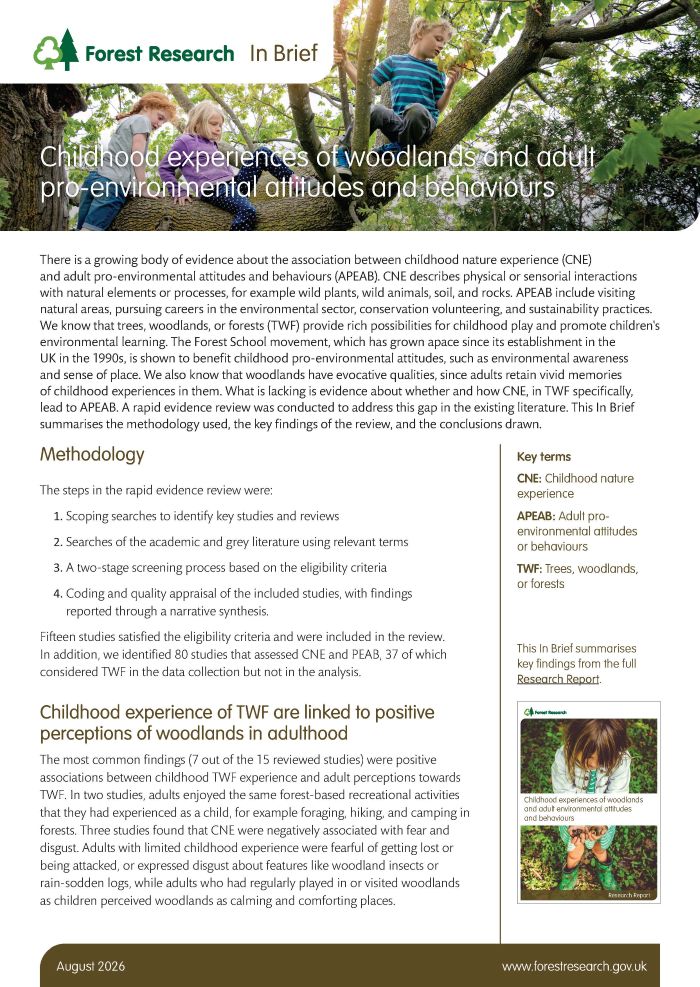
There is a growing body of evidence about the association between childhood nature experience (CNE) and adult pro-environmental attitudes and behaviours (APEAB). CNE describes physical or sensorial interactions with natural elements or processes, for example wild plants, wild animals, soil, and rocks. APEAB include visiting natural areas, pursuing careers in the environmental sector, conservation volunteering, and sustainability practices. We know that trees, woodlands, or forests (TWF) provide rich possibilities for childhood play and promote children’s environmental learning. The Forest School movement, which has grown apace since its establishment in the UK in the 1990s, is shown to benefit childhood pro-environmental attitudes, such as environmental awareness and sense of place. We also know that woodlands have evocative qualities, since adults retain vivid memories of childhood experiences in them. What is lacking is evidence about whether and how CNE, in TWF specifically, lead to APEAB. A rapid evidence review was conducted to address this gap in the existing literature. This In Brief summarises the methodology used, the key findings of the review, and the conclusions drawn.
Methodology
The steps in the rapid evidence review were
1. Scoping searches to identify key studies and reviews
2. Searches of the academic and grey literature using relevant terms
3. A two-stage screening process based on the eligibility criteria
4. Coding and quality appraisal of the included studies, with findings reported through a narrative synthesis.
Fifteen studies satisfied the eligibility criteria and were included in the review. In addition, we identified 80 studies that assessed CNE and PEAB, 37 of which considered TWF in the data collection but not in the analysis.
Childhood experience of TWF are linked to positive perceptions of woodlands in adulthood
The most common findings (7 out of the 15 reviewed studies) were positive associations between childhood TWF experience and adult perceptions towards TWF. In two studies, adults enjoyed the same forest-based recreational activities that they had experienced as a child, for example foraging, hiking, and camping in forests. Three studies found that CNE were negatively associated with fear and disgust. Adults with limited childhood experience were fearful of getting lost or being attacked, or expressed disgust about features like woodland insects or rain-sodden logs, while adults who had regularly played in or visited woodlands as children perceived woodlands as calming and comforting places.
Adults and teenagers were also less likely to describe forests as boring if they had regularly played in or visited woodlands as children, and adults who visited forests regularly were less likely to use electronic media during their general leisure time. Finally, adults who lived adjacent to woodlands as children were more likely to agree that trees had personal or spiritual meaning for them.
Frequency of woodland visits in childhood affects visits in adulthood
Another common finding was a positive association between woodland visits in childhood and adulthood, featuring in four studies. Results from two of these studies suggested that visits as a child had to be highly frequent (at least weekly) to influence adult visitation behaviours. Only one study explored APEAB, finding that women who spent a lot of time in forests as children formed strong relationships that led to their advocacy work for forests as adults.
Reviewed studies varied in extent of exploration of APEAB
Nine studies described the characteristics of the childhood experiences but did not consider how these could have influenced APEAB, or how these might compare to experiences in other types of greenspaces. In most cases, experiences were centred around creative play, for example making toys out of pinecones or creating dens, with woodlands often described as a place of freedom or escape. The environmental attitudes or behaviours of family members witnessed during childhood also influenced APEAB, although this relationship was not explicit in some studies.
Reviewed studies described a number of examples of childhood TWF experiences
The 37 studies where TWF featured in the data collection but not in the analysis described further examples of childhood experiences of TWF. These included: tree climbing, planting a tree, visiting the forest after dark, getting lost in the forest, building a forest shelter, cutting a trail through bushes or a forest, photographing trees, losing a forest to a forest fire, playing monkey tag in a tree, playing under a tree, hearing the wind rush through the trees, and collecting twigs.
More empirical research is needed
The limited number of studies identified by the review highlights the need for more empirical research investigating the potential influence of TWF-based CNE on APEAB. There were also significant evidence gaps, for example about the role of TWF in career choice, volunteering, or broader sustainability practices. Furthermore, all studies were based on adult memories of childhood experience, which may not be a wholly reliable source of data. Longitudinal studies or those focusing on young people’s recent experiences and emerging adult behaviours could be productive areas of enquiry.
Key terms
CNE: Childhood nature experience
APEAB: Adult pro-environmental attitudes or behaviours
TWF: Trees, woodlands, or forests