Underplanting extends range of coniferous tree species to diversify future commercial timber production
16 Feb 2026

New research by Forest Research, published in Forest Ecology and Management, shows that underplanting extends the range of coniferous tree species that could potentially be used to diversify future commercial timber production in the United Kingdom.
In the UK, commercial timber production is dominated by conifer forests consisting primarily of just nine introduced species, which poses serious risks to the UK forest industry due to the likelihood of future climate change and the increasing incidence of damaging pests and diseases.
Forest Research set up two experiments to test the suitability of 17 alternative species in a relatively warm, dry, location where opportunities for diversification are currently thought to be limited.
Dr Ian Willoughby FICFor, Principal Scientist, Forest Research said: “As expected, five years after planting on a conventional clear-cut site, apart from Scots pine, few other species had established. However, we found that Maritime pine grew well and would seem to have potential in our future climate on similar sheltered, freely draining clearfelled areas.”
When planted underneath an existing canopy of trees a much wider range of species thrived, with Douglas fir, grand fir, European silver fir, western red cedar, coast redwood and Leyland cypress all growing strongly.
However, we found that Maritime pine grew well and would seem to have potential in our future climate on similar sheltered, freely draining clearfelled areas.
During periods of very warm and very cold weather, the temperatures under the canopy were less extreme than on the open site.
The research concluded that underplanting appears to be a potentially useful technique, worthy of further study, for establishing shade tolerant, emerging species, which might otherwise prove to be unsuitable for deployment on clearfell sites – as long as the locations chosen are sufficiently windfirm for an overstorey crop to be retained.
To read the paper in full, visit Underplanting extends the range of coniferous tree species that could potentially be used to diversify future commercial timber production in the United Kingdom – ScienceDirect

A new sweet chestnut blight outbreak has been confirmed in Devon, read how Mick Biddle’s Forest Research trial is advancing potential treatments and what this means for the newly introduced demarcated area.
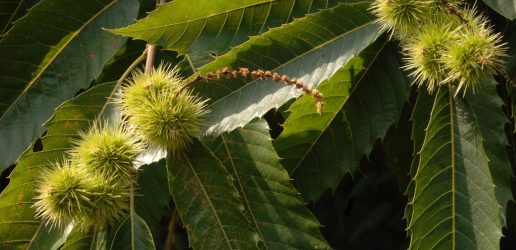
Forest Research, working with The Royal Horticultural Society (RHS) and Coventry University, is calling on woodland owners and the public to help check on the health of sweet chestnuts (Castanea sativa) this spring and summer.

A new national map showing the location of trees outside of woodlands across Wales is now available for the first time.
A new sweet chestnut blight outbreak has been confirmed in Devon, read how Mick Biddle’s Forest Research trial is advancing potential treatments and what this means for the newly introduced demarcated area.
Forest Research, working with The Royal Horticultural Society (RHS) and Coventry University, is calling on woodland owners and the public to help check on the health of sweet chestnuts (Castanea sativa) this spring and summer.
A new national map showing the location of trees outside of woodlands across Wales is now available for the first time.