
Date
2 April 2026
Reading Time
4 minutes
Last Updated
2 April 2026
Riparian woodland often provides little direct economic return for landowners but many environmental and societal benefits, including clean water, flood mitigation and cooler water temperatures. Restoring and expanding riparian woodland along our streams and rivers to deliver these increasingly needed benefits therefore requires funding support to incentivise land use change.
The Kennetsideshead Farm woodland creation project, delivered in partnership with the Tweed Forum and Borders Forest Trust, demonstrates how this can be achieved. The project is carefully designed to deliver a wide range of benefits and ecosystem services across the landscape, while supporting the farm’s goal of diversifying its core agricultural business.
Working with Forest Research, the project piloted the use of an innovative ‘Woodland Water Code’ (WWC) to quantify the water quality, flood and shading benefits provided, so that these can be properly valued and potentially support private investment to deliver more woodland planting where most needed.
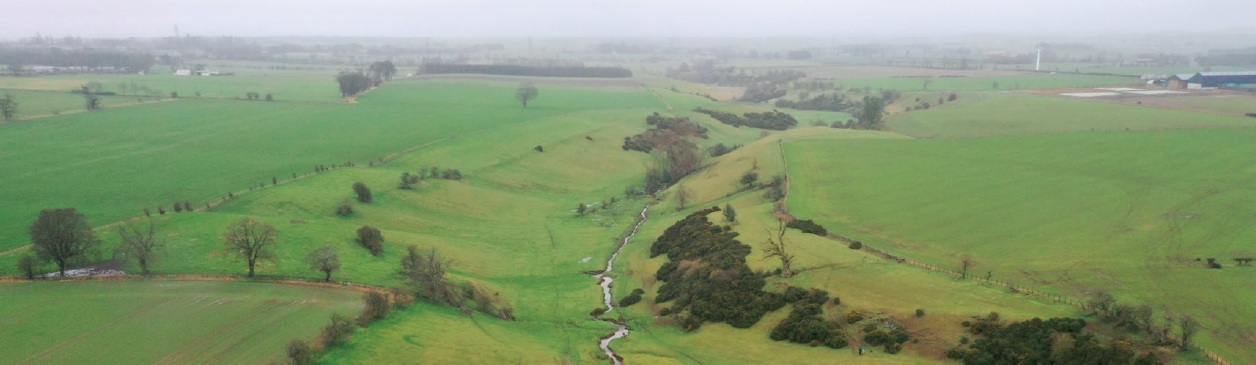
Local Context
Located in the Scottish Borders, Kennetsideshead Farm was previously a large dairy and mixed arable farm with limited woodland cover. This is now changing with the creation of 31.4 ha of mixed native riparian woodland planting along the Lambden Burn. The stream flows into the Leet Water and eventually the River Tweed, a Special Area of Conservation owing in part to its high ecological diversity and salmon population. Scattered among the emerging saplings are several veteran trees, remnants of the valley’s historic woodland dating back to the 1800s.
Initially focused on diversifying the farm business and moving toward carbon neutrality, the project also aims to boost biodiversity, improve water quality, and create an amenity space for future generations. Riparian planting acts as a natural buffer, intercepting run-off from the adjacent land and reducing the delivery of nutrients and sediment into the stream, helping to tackle the local diffuse pollution issue. More trees along the riverbank also means more resilient habitat for fish and invertebrates, providing much needed shade to limit rising water temperatures.
Piloting
The Tweed Forum were keen to pilot the draft WWC during last summer, recognising its potential to value the water benefits provided by woodland and thereby strengthen the case for private investment to drive more woodland creation. They suggested Kennetsideshead Farm due to its close connection with the Lambden Burn, which flows through the heart of the farm.
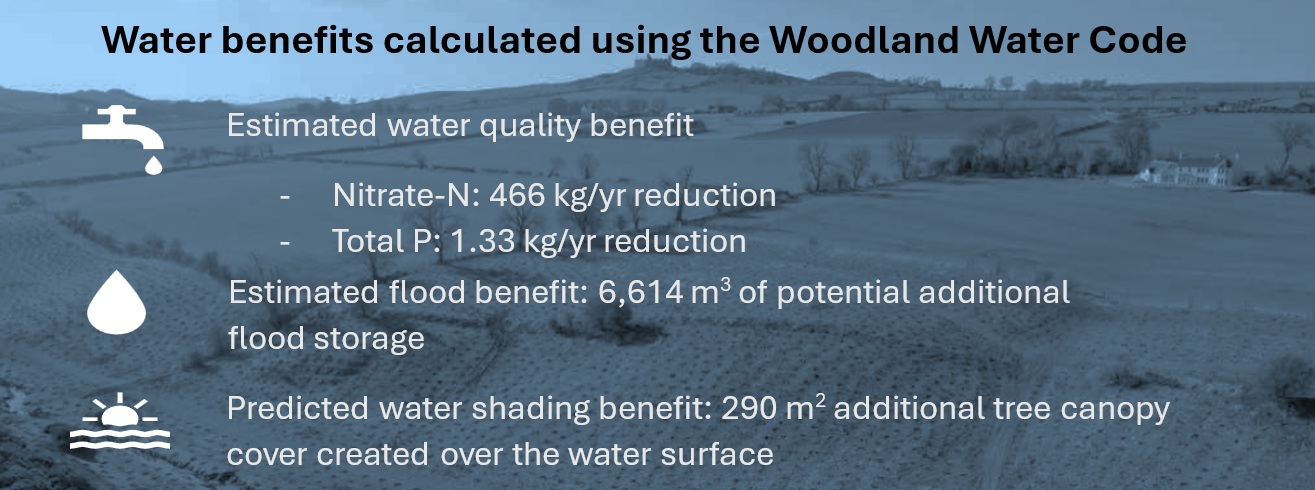
Piloting: impact and insights
The Tweed Forum provided valuable feedback on their experience with piloting the draft WWC.
Key points were:
- Overall, the guidance on applying the WWC was found to be concise and easy to follow.
- The calculation of Woodland Water Units (WWUs) was clear and straightforward to interpret.
- The use of modelled data driven by practitioner input was seen as a good compromise, delivering meaningful estimates without requiring overly complex or time-consuming data collection.
- Cross-border discrepancies were noted between mapping datasets.
Feedback from this and other projects were captured and the lessons learned improved the methodology and useability of the WWC.
Summary
Piloting the WWC at Kennetsideshead Farm has provided key insights for both the Tweed Forum and WWC teams on the water benefits provided by riparian woodland. By applying the WWC calculators the Tweed Forum have gained valuable evidence to support future business cases for greater private investment in woodland creation.
With its carefully targeted transition from agricultural land to woodland, Kennetsideshead Farm exemplifies the type of project which can contribute to achieving government targets for woodland creation, clean water and flood mitigation whilst maintaining the core agricultural business. The WWC demonstrates how payments for water benefits supported by green finance could enhance profitability of tree planting to deliver transformative change. The feedback received from the Tweed Forum has helped to refine and improve the code, strengthening its ability to potentially support similar initiatives across the UK.
Recent News
View All news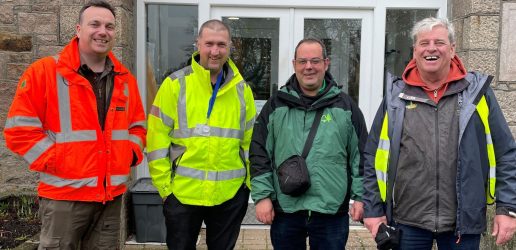
New research investigates potential biocontrol programme to manage sweet chestnut blight
A new sweet chestnut blight outbreak has been confirmed in Devon, read how Mick Biddle’s Forest Research trial is advancing potential treatments and what this means for the newly introduced demarcated area.
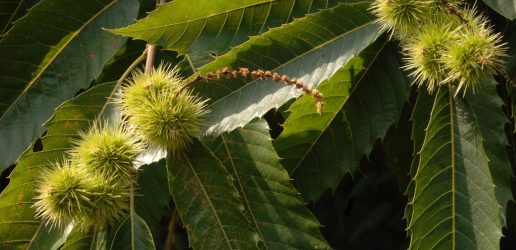
Check a sweet chestnut this spring and summer
Forest Research, working with The Royal Horticultural Society (RHS) and Coventry University, is calling on woodland owners and the public to help check on the health of sweet chestnuts (Castanea sativa) this spring and summer.

Trees outside of woodlands identified across Wales
A new national map showing the location of trees outside of woodlands across Wales is now available for the first time.
New research investigates potential biocontrol programme to manage sweet chestnut blight
A new sweet chestnut blight outbreak has been confirmed in Devon, read how Mick Biddle’s Forest Research trial is advancing potential treatments and what this means for the newly introduced demarcated area.
Check a sweet chestnut this spring and summer
Forest Research, working with The Royal Horticultural Society (RHS) and Coventry University, is calling on woodland owners and the public to help check on the health of sweet chestnuts (Castanea sativa) this spring and summer.
Trees outside of woodlands identified across Wales
A new national map showing the location of trees outside of woodlands across Wales is now available for the first time.