
Oak processionary moth (OPM) caterpillars, or larvae, are covered with thousands of minute, irritating hairs. These can be released as a defence mechanism, or blown off by the wind, and come into contact with people and animals. Contact can cause symptoms ranging from a mildly itching rash to allergic reactions.
The caterpillars build communal nests on the trunks and branches of oak trees to protect themselves from predators. Once released, the hairs can persist in the nests and the environment, such as on tree bark or grass, for a year or more, posing a long-term nuisance to people and animals unfortunate enough to come into contact with them.
To protect tree, public and animal health, the Government encourages owners of infested trees to engage tree or pest control professionals to destroy OPM caterpillars and nests. These workers, as well as others who work on or close to oak trees in the affected areas, are exposed to an occupational health risk which must be managed.
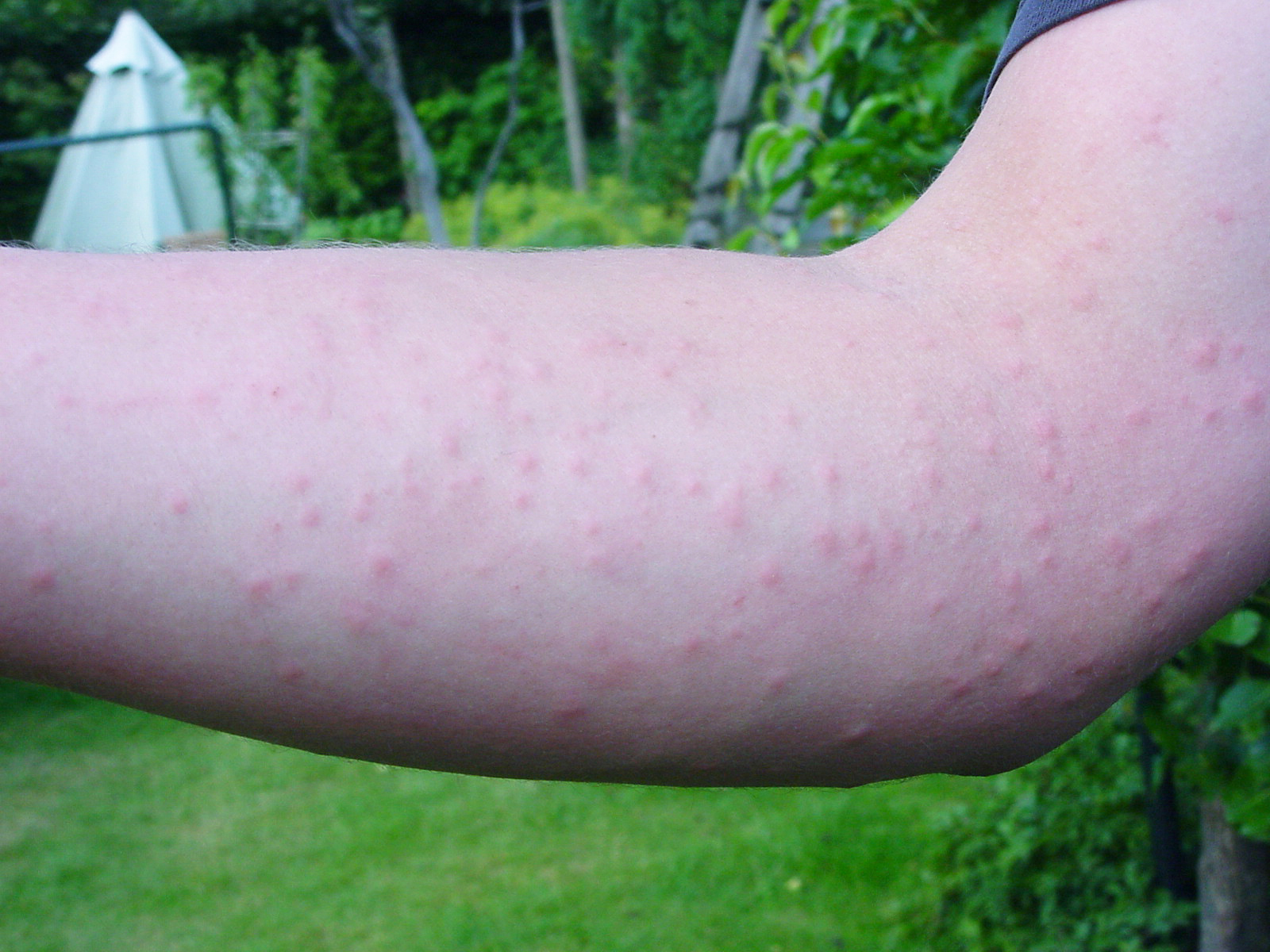
Effects of exposure
Picture: Henry Kuppen
Contact with the hairs, which contain an urticating (irritating) substance called thaumetopoein, is known to cause a number of conditions, including:- skin irritation, rashes (see picture) and itching;
- eye complaints; and
- breathing difficulties.
Occupational risk
Forestry workers and tree surgeons are at greatest risk of exposure because their work brings them into close contact with trees. Arborists, landscapers, gardeners and ground-care professionals, such as greenkeepers, are also at heightened risk because of the nature of their work and the amount of time they spend close to trees. These workers should take particular care to protect themselves when working with or close to oak trees with OPM nests or caterpillars. Such workers must therefore be vigilant, and their employers must employ an adequate occupational health monitoring system.Prevention, mitigation and treatment
Before starting work on trees in the OPM-affected areas, consider the likelihood and risk of exposure to OPM and any mitigating measures which might be needed, for example:- Is the work area within or near a known OPM-infested area? See the map at our OPM landing page to check where these are.
- Is there site-specific information about OPM presence? The property manager should be able to tell you. If not, the Forestry Commission can help if OPM presence has been reported to it: contact opm@forestrycommission.gov.uk. It helps to have the Ordnance Survey grid references for the site to hand when you contact the commission.
- Will you be working on oak trees, or are oak trees present on site? Again, the property manager should know.
- Is there evidence of OPM infestation on or near the trees you are working on?
- avoid direct contact with caterpillars and their nests; and
- wear, as a minimum, long-sleeved tops and long trousers with the cuffs tucked in. Gloves, goggles and a balaclava can increase protection of the head and hands, and a dust mask can reduce the potential for hairs to enter the mouth, throat and airways. Full personal protective equipment (PPE) should be used if direct contact with hairs is likely. See below.
- Face mask to prevent inhalation – Filtering half mask FFP2 or FFP3 (European standard EN149: 2001), disposable, to protect against particles
- Goggles to protect the eyes – complying with European standard EN166 and either Code 4 or Code 5
- Disposable spray suit to prevent skin contact – An impermeable protective suit suitable for insecticide spraying will also protect against the caterpillars’ hairs.
- Gloves to protect skin contact – Robust water- and chemical-resistant gloves, as used for spraying operations
- Boots to prevent skin contact – Water-proof and chemical-resistant rubber boots, as used for spraying operations
Employers’ responsibilities
Employers have certain responsibilities for their own and their employees’ safety. Their legal responsibilities are covered by the following legislation:- Control of Substances Hazardous to Health Regulations (COSHH) 2002;
- Management of Health and Safety Regulations 1999;
- Reporting of Injuries, Diseases and Dangerous Occurrences Regulations (RIDDOR) 1995; and
- Personal Protective Equipment at Work Regulations 1992.
- undertaking risk assessments;
- identifying and enacting control measures, and ensuring these are used, for example, staff awareness of OPM, how to identify nests and caterpillars, and what to do if it is discovered;
- providing their employees with suitable PPE;
- having a system for employees to report defective equipment;
- providing their employees with information and training on the health risks and control measures, including skin checks;
- providing suitable welfare facilities, such as washing facilities; and
- providing a health surveillance programme.
Employees’ responsibilities
Employees should:- take reasonable care of their own health at work;
- follow recommended systems of work;
- use the equipment, including the PPE, which their employers have provided;
- keep equipment, such as ropes and gloves, used on OPM-infested trees separate from equipment used on other trees;
- report any defects or problems with the equipment to their employers;
- attend any training or instruction provided by their employers;
- inform their employers if they have health concerns;
- attend any health surveillance programme or health checks which employers have put in place; and
- consult a GP if their employers have any concerns about their health after working near OPM.
Suggested treatments
For skin symptoms:- Calamine lotion or other similar creams available from a pharmacy can be used to relieve itching.
- Corticosteroid cream might be recommended by doctors to relieve severe or prolonged itching.
- Doctors might also recommend oral antihistamine medicines in tablet, capsule or syrup form where appropriate. However, antihistamine skin creams are not advised because of their potential to sensitise.
- See a doctor as soon as possible.