
Overview
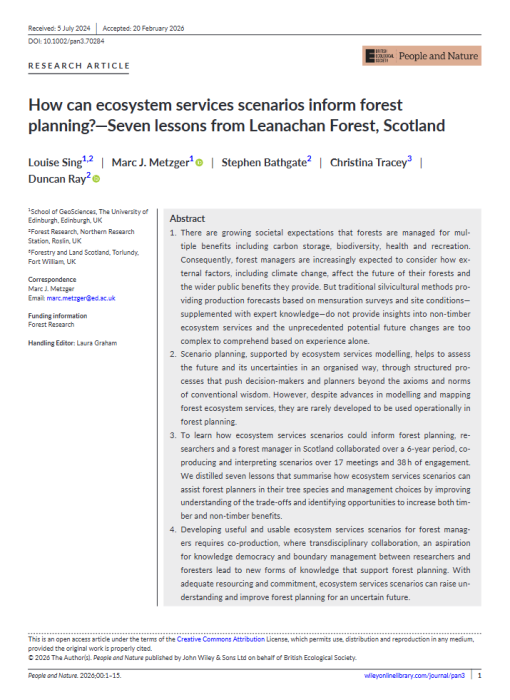
Forest managers now need to balance timber with wider benefits such as biodiversity, recreation, carbon storage, and climate resilience. Traditional methods often overlook these. This study explores how scenario planning can support better long‑term decisions.
Over six years in Leanachan Forest in northwest Scotland, researchers and the forest planning manager tested how maps and models of ecosystem services — carbon, habitat, recreation — could inform planning. Using a co‑production approach, they worked through six stages: defining the problem, gathering data, mapping current services, modelling scenarios, interpreting results, and reflecting on learning.
Six scenarios were tested, combining different species and management styles, from traditional planting to nature‑focused and climate‑adapted options. Results showed that choosing species suited to Leanachan’s varied sites could boost biodiversity and recreation without major losses in timber.
Seven key lessons emerged:
- Scenarios can reveal new planting and management options that support wildlife and recreation while maintaining timber yields.
- Scenario tools help managers understand trade-offs between goals, such as carbon storage versus biodiversity.
- Visualisation tools are essential; maps and interactive tools help explore long-term outcomes.
- Data limitations restrict what can be included, especially for services like water quality or detailed biodiversity.
- Knowledge gaps about climate impacts on tree species make long-term planning uncertain.
- Time and stakeholder involvement matter; more time and wider input would have strengthened the process.
- Long-term collaboration is crucial; success depended on sustained engagement between researchers and practitioners.
Overall, collaborative scenario planning helps managers consider multiple benefits and risks, supporting better decisions under climate uncertainty. It requires suitable tools, data, time, and commitment.