
Summary
Summary

Many people take pleasure from activities in forests and wild lands in the UK and others are being encouraged to participate. These inevitably incur certain risks, however, and one of the most insidious is the possibility (albeit tiny) of acquiring a disease from wild animals; for example, ticks can be vectors of the bacterial infection leading to Lyme disease. Both diagnosis and treatment can be problematic so prevention of acquiring such disease is highly desirable.
 This project considered ways to help those involved in the countryside to understand better how to deal with diseases such as Lyme disease, how to communicate the degree of risk effectively, and how to encourage preventative action such that the countryside continues to be a source of pleasure and well-being for its users.
- Research summary (PDF-545K)
- Final report, RELU policy note, research papers, book chapters and other publications.
Research objectives
Surprisingly little is known about how best to warn countryside users about the potential for disease without scaring them away or spoiling their enjoyment. Answering such questions was the goal of this project, and required an interdisciplinary approach that integrated a diverse set of scientific skills including:
- Forest ecology
- Parasite ecology
- Environmental and social psychology
- Sociology and political science.
The project also required an understanding of the views of:
- Those who manage countryside
- Those who have contracted zoonotic diseases
- Those who access the land.
Research activities
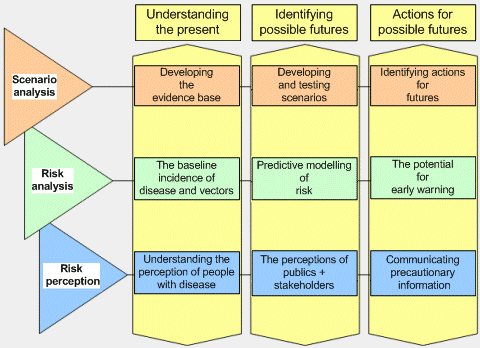
The work consisted of three phases:
- Understanding the present
- Identifying possible futures
- Actions for possible futures.
Within each of these phases, work considered scenario analysis, risk analysis and risk perception:
A Project Advisory Board provided specialist advice on aspects of the research, and a Practitioner Panel guided the practical implementation of the findings.
Research outputs
Final report, RELU policy note, research papers, book chapters and other publications.
Risk and uncertainty in the context of animal and zoonotic disease management workshop
Held over two days in November 2010, this workshop showcased and discussed the work of three related RELU funded projects with presentations of findings from those projects and an exploration of their relevance and potential future applications.
Workshop summary and presentations
Funders and partners
The inter-disciplinary team of researchers involved staff from Forest Research, the University of Oxford and the University of Surrey.

The research was conducted as part of the Research Councils’ Rural Economy and Land Use (RELU) Programme (Project: RES 229-25-0007). RELU is funded jointly by the Economic and Social Research Council, the Biotechnology and Biological Sciences Research Council and the Natural Environment Research Council, with additional funding from the Department for Environment, Food and Rural Affairs and the Scottish Executive Environment and Rural Affairs Department.



Additional funding for the project was provided by the Forestry Commission and the Universities of Oxford and Surrey.
Status
The project commenced on the 1st September 2007 and the final report was produced in March 2011.
Contacts and further information
About the research
For further information on the project as a whole, contact:
The work on risk analysis was led by Professor Sarah Randolph:
Sarah Randolph
Professor of Parasite Ecology
Department of Zoology,
University of Oxford
Email: sarah.randolph@zoo.ox.ac.uk
The work on risk perception was led by Dr Julie Barnett and Professor David Uzzell:
Dr. Julie Barnett
Reader in Healthcare Research
Department of Information Systems and Computing
Brunel University
Email: julie.barnett@brunel.ac.uk
Professor David Uzzell
Department of Psychology
University of Surrey
Email: D.Uzzell@surrey.ac.uk
For information about the RELU programme in general, see www.relu.ac.uk/
About zoonotic diseases including Lyme disease
The project team are unable to advise on specifics of Lyme disease or on any medical aspects. Further information is available at the websites listed below.
Authoritative health protection advice:
Information on other aspects of zoonotic diseases:
- Zoonotic diseases (zoonoses): guidance, data and analysis (GOV.UK)
- Zoonoses and veterinary public health: disease surveillance reports (GOV.UK)
- World Health Organisation
- Centers for Disease Control and Prevention, USA
- National Center for Zoonotic, Vector-Borne, and Enteric Diseases(NCZVED)
Workshop on risk and uncertainty in the context of animal and zoonotic disease management
3rd to 4th November 2010, Royal York Hotel.
Overview
This workshop showcased and discussed the work of three Research Council Rural Economy and Land Use (RELU) funded projects:
- Reducing E coli risk in rural communities
- Assessment of knowledge sources in animal disease control
- Assessing and communicating animal disease risks for countryside users
Held in four sessions over two days, the workshop involved presentations of findings from the projects and an exploration of their relevance and potential future applications:
- Session 1: Integrating evidence on intervention for policy
- Session 2: Organisational responses: influencing behaviour and communicating risk
- Session 3: Devising frameworks and identifying uncertainties in animal disease management
- Session 4: Applications and implications of the research (group discussion).
The first day included a presentation on a European perspective by Prof. Ekdahl from the European Centre for Disease Prevention and Control.
Workshop report (PDF-93K)
Introductory and non-session presentations
- RELU Programme and Animal Disease Management: Welcome from chair (PDF-532K)
Prof. Philip Lowe, RELU - Communicating risk from a European Perspective (PDF-438K)
Prof. Karl Ekdahl, European Centre for Disease Prevention and Control
Session presentations
- Assessing and communicating animal disease risks for countryside users (PDF-482K)
Dr. Chris Quine, Forest Research - Session1_David_Oliver_et_al_RELU_Risk_York_Nov2010.pdf (PDF-468K)
David Oliver, Sophia Latham, Jonathan Wastling and Phil Haygarth, Lancaster University - Devising frameworks and identifying uncertainties in animal disease management (PDF-255K)
Paul Cross (Bangor University), Dan Rigby (Manchester University) and Gareth Edwards-Jones (Bangor University) - Devising frameworks and identifying uncertainties in animal disease management (PDF-954K)
Dr. Zoe Austin, Lancaster University - Integrating Evidence on (potential) Intervention for Policy (PDF-2926K)
Sarah Randolph, University of Oxford - Organisational Responses: Influencing Behaviour and Communicating Risk (PDF-658K)
Dr. Julie Barnett, Brunel University - Reducing Escherichia Coli O157 Risk in Rural Communities: Individual experiences and risk meanings (PDF-4258K)
Colette Jones (University of Aberdeen) and Dan Rigby (Manchester University) - Reducing Escherichia Coli O157 Risk In Rural Communities: Integrating Evidence For Policy (PDF-1889K)
Norval Strachan, John Farrington and Colette Jones, University of Aberdeen - Reflections on the presentation “Organisational responses: Influencing behaviour and communicating risk” (PDF-229K)
Dr. Zoe Austin, Lancaster University - What do I fear, what can I control? (PDF-734K)
Seda Erdem and Dan Rigby, University of Manchester
Assessing and communicating animal disease risks for countryside users – project outputs
General Content
What’s of interest
Risk and uncertainty in the context of animal and zoonotic disease management
Workshop held in November 2010.