Research
Ecology of upland native woodlands
Research Status:completed

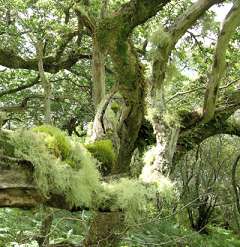
This research programme is investigating the influence of different management options and ecological processes on the condition of upland native woodland habitats. Practical tools are being developed for woodland managers.
The main themes of this programme are:
The research work is divided into the following areas:

This work forms part of the Ecosystems and Biodiversity research programme which is funded by the Forestry Commission.
Work completed under this programme has also been funded by:
A study has been undertaken in partnership with Stirling University’s Centre for Environmental History.
There are several trends which influence the current condition of our upland native woodland resource and have implications for management:
The UK Biodiversity Action Plan encompasses several HAPs for upland woodland types: upland oakwoods, upland mixed ashwoods, native pinewoods and, in part, wet woodlands. The HAP for Upland Birchwoods in Scotland awaits publication but is also of relevance to this programme. HAPs contain targets for the:
These plans have generated a lot of activity and much has been achieved. However, it is not always obvious which management option to select, and improved guidance is required. Similarly, new methods are needed to assess habitat responses and inform the future direction of management.
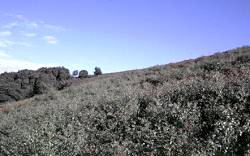 Natural colonisation (the natural regeneration of trees on land adjacent to existing woodland) is the preferred means of achieving native woodland expansion.
However, it is often difficult to predict how successful this process is likely to be. A range of factors need to be considered when assessing the potential of new schemes and planning remedial action on unsuccessful sites.
A survey of colonisation schemes was undertaken for Forestry Commission Scotland. The focus was on Highland birchwoods and native pinewoods. Each scheme was assessed to determine the dispersal of seedlings across the site, influence of soil nutrient and soil moisture regime together with vegetation structure.
The main findings from this research were summarised and presented in Forestry Commission Information Note 54:
 Age structure of Atlantic oakwoods
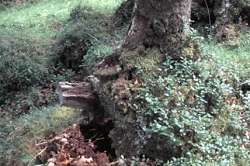
This study, undertaken as part of the LIFE ’97 Atlantic oakwoods project, assessed the recent history of five upland oakwoods, comparing age histograms (derived from cores) with field evidence.
Two of the stands showed clear signs of intensive use for production of charcoal and tanbark. A range of past management activities appeared to operate in the other woods, from wood pasture to clearfelling followed by natural regeneration.
The following report presents results and summarises the history of Scottish and Welsh Atlantic oakwoods:
Analysis of age structure in Atlantic oakwoods – implications for future woodland management (PDF-816K)
There has been renewed interest in recent years in the utilisation of timber from these woodlands, many of which are Special Areas of Conservation (SAC). George Peterken and Rick Worrell have looked at the potential for promoting rural development whilst maintaining Favourable Conservation Status. Their report suggests several management models:
The long-rotation High Forest Model is appropriate for stands of mature oak coppice.
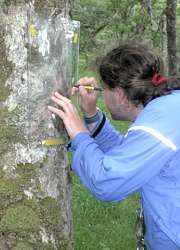
Photo by Joe Hope
Atlantic woods within the British Isles are internationally recognised for their lower plant interest. There is no evidence to show what the impact of tree felling is on species survival and abundance. Thinning trials have been set up to assess this.
Current thinning treatments are:
Detailed baseline studies have been undertaken to record epiphytic lichen communities, patch size of selected lichen thalli and saxicolous bryophytes. Response to thinning will be assessed.
Initial surveys of lower plants, potential veteran trees and potential timber trees were synthesised to provide guidance for the selection of stands and trees when thinning Atlantic woods. This work was part funded by LIFE Nature under the Core Sites for a Forest Habitat Network project and guidance has been published by Highland Birchwoods:
FREUNW_AtlanticWoodlandsLR.pdf (PDF-1570K)
LIFE Nature commissioned research into dynamics of woodlands in the Clyde Valley and the consequences of management being undertaken through the Core Sites for a Forest Habitat Network project.
Assessments were made of tree regeneration and vegetation in relation to canopy conditions. However, it became apparent, as the study progressed, that a major influencing factor over the existing condition of the Clyde Valley woods and their response to management, was the historic use and management of each site.
A desk based study (part funded by SNH and LIFE Nature) was undertaken by Stirling University’s AHRC Centre for Environmental History to assess mapped and documentary evidence and to summarise the history of the woods concerned in this project. The report completed by Forest Research, draws from the woodland history report and makes recommendations for management in the light of previous woodland uses and current conditions.
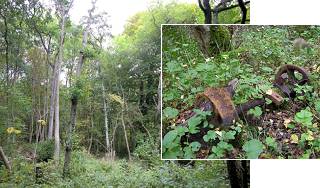
Jock’s Gill
This area was part of a formal landscape in 1816 (a mature beech tree can just be seen in the background which dates back to this period). It was planted with mixed broadleaves and conifers between 1816 and 1858, felled in 1933 and subsequently regenerated.
The inset shows an axle from a tram cart – evidence of a 19th century brick works located nearby, now within woodland.
Management plans are no longer the preserve of nature reserves or estates. They are becoming a standard tool of woodland management and increasingly form the mechanism for securing grant aid.
A framework for management planning is under development to simplify the process of writing the plan, following plan actions and revising management in response to monitoring. The format aims to ensure that management objectives and desirable woodland conditions are achieved.
This framework will be included in the forthcoming handbook: “Management of native broadleaved woodlands”.
Managers often undertake monitoring to comply with certification or as a condition of grant aid. However, unless careful thought is given to the purpose of monitoring, data may be collected in an inappropriate way and it may be difficult to determine the meaning of results.
Guidance is in preparation to provide a rationale for monitoring and to identify the difference between strategic / research monitoring and that needed at the site level to inform management decisions. The focus of current work is on planted ancient woodland sites (PAWS) vegetation monitoring.
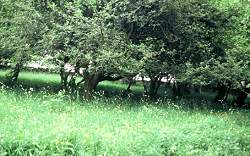 Assessment of over-grazing in English upland native woodlands
This project was carried out under this ecology of upland native woodlands programme and is covered under the Impacts of large herbivores on woodlands programme pages. It illustrates a quick and simple qualitative approach to woodland assessment.
A judgement – based method to identify overgrazing in English upland native woodlands
PAWS are ancient woodland sites where the semi-natural woodland has been replaced with a plantation.
The sub-set of most relevance are those sites planted with non-native species since 1930. A substantial proportion of PAWS are either under restoration or likely to be restored over the next 20-30 years.
There is currently a lot of emphasis on the use of gradual methods to convert the plantation to a native woodland using alternative silvicultural systems to clearfell. Under this ecology of upland native woodlands programme and the Lowland Native Woodlands programme, we are undertaking a number of experiments to determine the appropriate approach for a range of former woodland types.
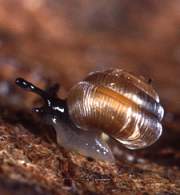
Forest snail photo by Richard Marriott.
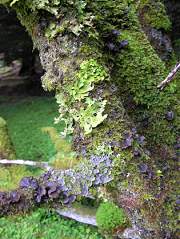
An experiment has been established in Glencripesdale National Nature Reserve to assess the condition and diversity of ancient woodland communities in remnants within a PAWS. Remnants will be reassessed following clearfelling. The main groups under investigation are epiphytic lichens and molluscs.
This experiment is also looking at the rate of ground vegetation colonisation from under plantation gaps into areas currently dominated by needle litter. An assessment of the soil seed bank is being undertaken to show what role this plays in vegetation development following clearfelling.
Monitoring is useful in determining the need for management and the effects of management. During the restoration process, a number of activities will be necessary:
Simple qualitative methods are under development. The aim is to make monitoring straightforward and suited to delivering meaningful results that will have a direct impact on management. For further information contact Ralph Harmer.
Restoration of native woodland on ancient woodland sites
This Forestry Commission Practice Guide provides advice on why, where and how to restore PAWS. A framework allows the assessment of restoration potential of a site or ranking of a range of sites.
Restoration methods are discussed with advice given on the protection of ancient woodland remnants and development of native woodland.