
Present in United Kingdom
Notifiable – No
Scientific name – Hylobius abietis (H. abietis)
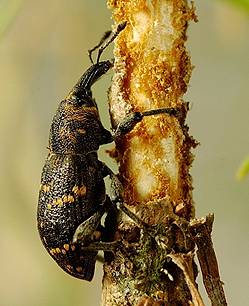
Hylobius abietis (L.), the large pine weevil (shown above), also known as the large brown pine weevil, is a major insect pest affecting a wide range of young tree species. It poses a particular problem in the UK and across much of Europe during the first five years after restocking (replanting) of commercial conifer forests but can also impact recently replanted broadleaved sites. It is especially damaging to seedlings of pine (Pinus genus)and spruce (Picea genus), both of which are commonly grown in the UK for softwood timber production.
Distribution
H. abietis is a native pest of coniferous plantations in many European countries and is widely distributed throughout the United Kingdom. It also occurs in Russia, Japan and China.
Susceptible species
H. abietis is polyphagous, capable of damaging nearly all conifer species as well as some deciduous trees. Feeding studies indicate a clear preference for conifers particularly Pinus sylvestris (Scots pine), although Picea sitchensis (Sitka spruce), Picea abies (Norway spruce), and Pseudotsuga menziesii (Douglas fir) are also highly attractive food sources. In contrast, less damage tends to occur on seedlings of Fagus sylvatica (beech) and Quercus robur (oak).
The threat
The large pine weevil poses a major threat to newly established forests particularly during the first five years after restocking a clear-fell site. Adult Hylobius are attracted to recently cut conifer stumps, where they congregate to mate and lay eggs. Once hatched, larvae feed on the cambial layer beneath the stump bark, progressing through four instar stages before pupating and emerging as adults. These adults then feed on nearby trees, including any vulnerable newly planted trees.
Unprotected trees on restocked sites are highly susceptible, and in severe cases, large pine weevil infestation can result in total crop failure even where insecticide protection has been applied. The large pine weevil is a serious threat to the UK’s softwood timber production, with the greatest risk to the establishment of replacement crops of conifers, such as pines, spruces, firs, and hemlocks, following harvest. In the absence of conifers, restocked broadleaved sites can also suffer damage.
The UK’s conifer forests support hundreds of millions of pounds in investment and sustains thousands of jobs across nursery production, forestry operations, timber transport, and timber processing industries. Maintaining the health of these forests is critical and it is essential that forest and woodland managers remain vigilant for Hylobius infestation and act promptly to minimise losses.
See ‘Management and control’ and ‘Related materials’ below for links to advice and guidance for forest managers.
Identification and symptoms
Adult weevils are mostly nocturnal and as a result may go unnoticed although they are sometimes active in daylight, particularly when populations are high. They can be encountered throughout the year but are less frequent in winter, as they remain inactive for extended periods below ground.
Adults measure around 10–13 mm in length (excluding the elongated snout or rostrum) and are dark brown with irregular patches of yellow or light brown hairs on the wing cases. Their legs are black or reddish-brown, each with a distinctive tooth on the femur (the leg segment nearest the body) and another at the tip of the tibia (the lower leg).
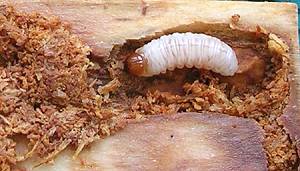
Fully developed larvae are cream-coloured, soft-bodied, and curved, reaching 14–16 mm in length. They have a hardened brown head and lack legs.
Adult activity is usually recognised by feeding damage to the bark of young trees, most noticeably between April and September. This appears as patches of removed bark, known as feeding scars, which can deform or kill seedlings.
Report a sighting
UK foresters are trained to be alert for large pine weevil, and how to control it, so we do not require reports of suspected sightings from members of the public.
Life cycle
Adult large pine weevils lay their eggs in or near the stumps and roots of felled or dead conifer trees, as their immature stages can only develop within this material.
After the eggs hatch, the larvae and pupae complete their development inside the stumps, where they cause no damage to living trees.
Upon emerging as adults, they walk or fly to living trees and other woody plants to feed. The nearest hosts are often young conifer trees that have been planted or have regenerated naturally to replace the felled crop. Sites with both stumps and young conifers present simultaneously are particularly vulnerable to attack and damage.
Adults are capable of travelling up to two kilometres within a few days, meaning that if no trees are available on the emergence site, nearby recently restocked areas or other young conifer stands in the vicinity remain at risk.
Management and control
It is therefore recommended that an integrated approach is adopted for managing this pest. Such an approach begins with understanding the life cycle of Hylobius, the timing of its activity, and the extent of damage it can cause. Managers are then encouraged to consider the full range of available methods—ranging from silvicultural practices and fallow periods to physical, chemical, and biological controls—to minimise risk. A successful strategy will usually involve combining more than one technique and tailoring interventions to suit site-specific conditions, ensuring the best chance of protecting young trees while supporting sustainable forestry.
Hylobius Management Support System (MSS) – Forest Research
Our research
Forest Research leads work developing non-chemical and reduced-chemical means of dealing with large pine weevil, including developing integrated pest management strategies. You can read more about this research here: Integrated forest management of Hylobius abietis – Forest Research
Related materials
- Managing the pine weevil on lowland pine
-
Resistance of young conifers to feeding damage by pine weevil
- The assessment of site characteristics as part of a management strategy to reduce damage by Hylobius
- Managing the threat to restocking posed by large pine weevil: the importance of time of felling of spruce stands
- Developments in the integrated management of pine weevil
- The influence of a changing climate on development and life cycle in the pine weevil, Hylobius abietis
- Are there viable chemical and non-chemical alternatives to the use of conventional insecticides for the protection of young trees from damage by the large pine weevil Hylobius abietis L. in UK forestry?