
Present in UK
Notifiable – see ‘Report a sighting’ below
Scientific name of causal agent – Cryphonectria parasitica
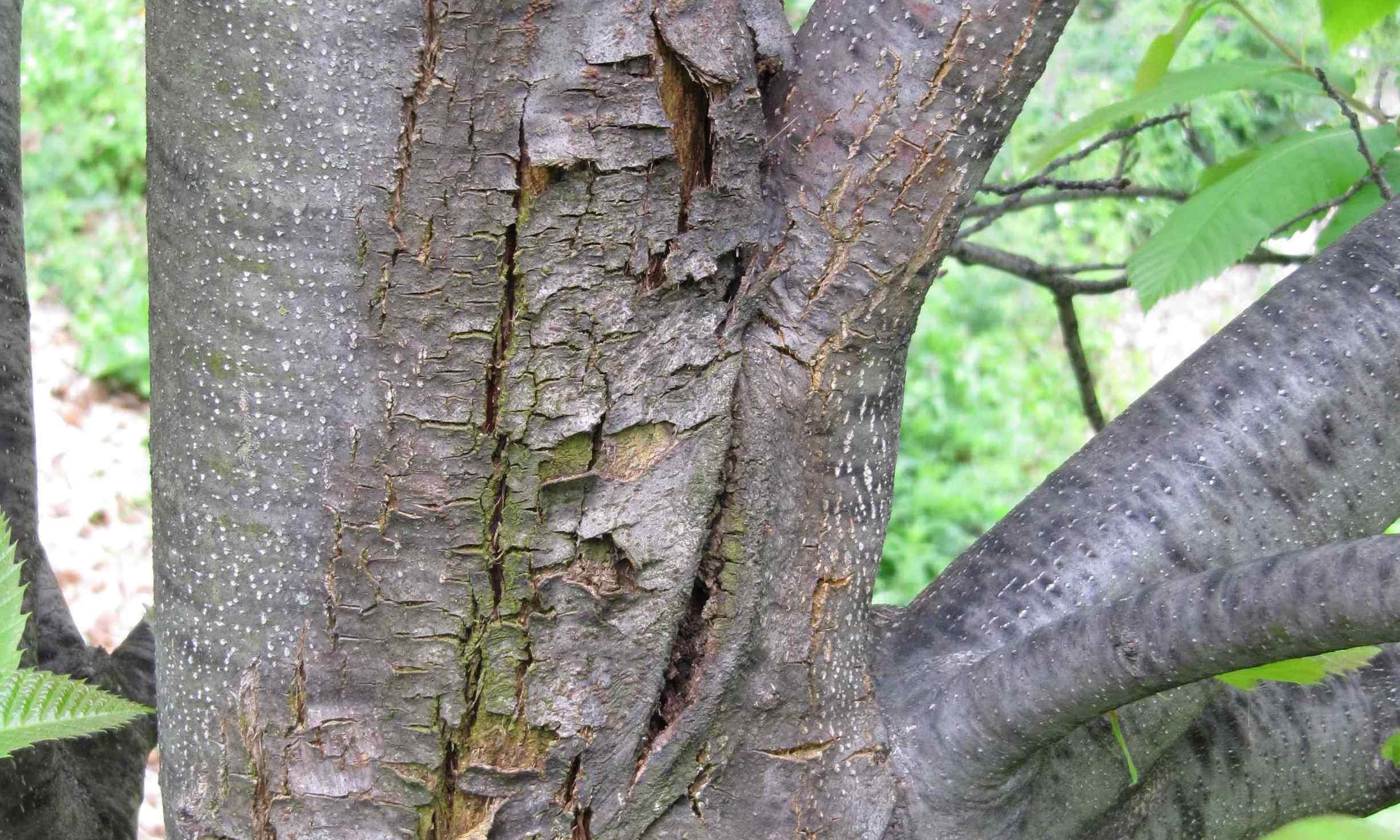
Picture: D. Rigling
Sweet chestnut blight is a destructive disease of sweet chestnut trees (trees in the Castanea genus) caused by the ascomycete fungus Cryphonectria parasitica. It was formerly known as Endothia parasitica. In certain circumstances it can also affect other tree species including oak (Quercus spp.)
Distribution
The Cryphonectria parasitica fungus has caused severe epidemics of sweet chestnut blight over large areas of North America. (See ‘Origins and background’ below.) It has also affected European sweet chestnut (C. sativa) over a wide area of continental Europe. Since 2011 it has been found at a number of sites in the United Kingdom, principally in central and southern England.
- Map of locations of confirmed findings in Great Britain, showing 10 km × 10 km grid squares in which at least one case has been confirmed.
- European countries and regions where it has been confirmed.
The threat
C. parasitica infection is usually fatal to European (Castanea sativa) and North American (C. dentata) sweet chestnut trees. It has almost wiped out North America’s sweet chestnut population.
Although losses have not been on the same scale in Europe, sweet chestnut blight has spread steadily throughout much of Europe, and tree losses and decline have been regionally significant.
Sweet chestnut woodland is not widely distributed in the UK. Most of it is in England, and it amounts to about 2 per cent of England’s wood cover. Most sweet chestnut woodland is in southern England, so any impact would be mostly regionally and locally felt.
Sweet chestnut trees are grown commercially for the timber and nut markets. These industries are small but locally important, particularly in Kent, where chestnut coppicing for the timber industry has been enjoying a revival during the early 21st century.
Susceptible species
C. parasiticais a serious pathogen mainly of American and European sweet chestnuts, although the latter might be less susceptible than their American relatives. The main species at risk in the UK are European sweet chestnut, which is grown for nut and timber production and for amenity purposes, and introduced plantings of American sweet chestnut which is much less frequently found in the UK.
The fungus can also occasionally affect some species of oak trees, usually when they are standing very close to heavily infected sweet chestnut trees. Susceptible oak species include Britain’s native sessile and, less often, pedunculate or English oaks (Quercus petraea and Q. robur respectively), as well as Holm oak (Q. ilex) and others. The cankers on oaks tend to be superficial bark infections which rarely cause the death of branches, sprouts or whole trees.
The European & Mediterranean Plant Protection Organization (EPPO) also lists Castanopsis species (chinquapins), Acer species (maples), Rhus typhina (staghorn sumac) and Carya ovata (shagbark hickory) as host species.
The disease poses no threat to people, pets or livestock, and it does not affect horse chestnut, or ‘conker’, trees (Aesculus hippocastanum), which are unrelated to sweet chestnut (Castanea) species. Nor is chestnut oak (Quercus prinus) affected.
Identification and symptoms
All symptoms on infected trees occur above the ground. C. parasitica attacks the bark of European sweet chestnut and enters through fissures or wounds. On grafted trees, infections are most frequently found in the region of the graft, where callusing occurs. In coppices or orchards, infections are often located at the base of the stem (collars or insertion points), although bark death does not spread into the root system.
The top picture shows bark death and cracking caused by C. parasitica infection.
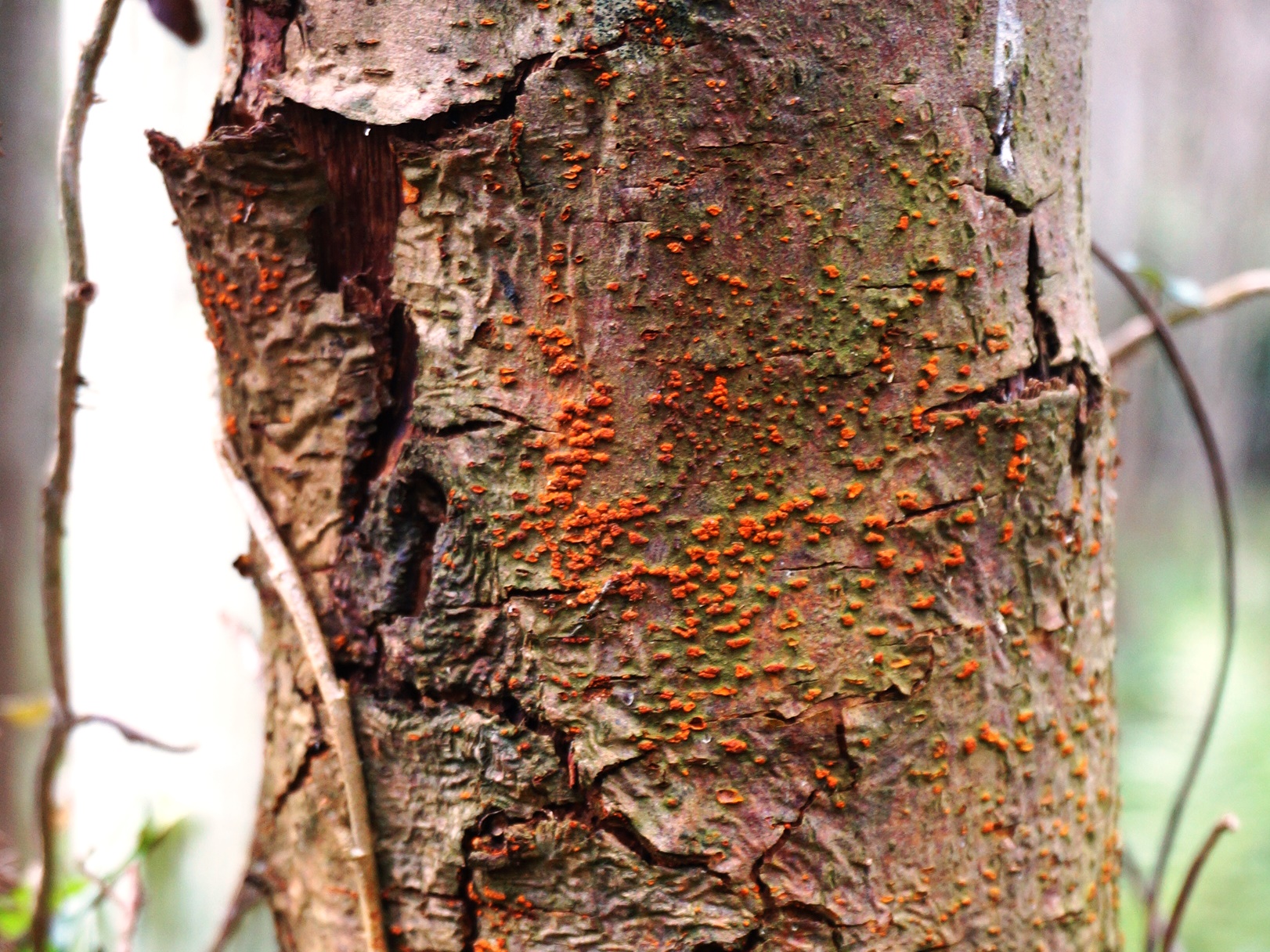
Picture: Forest Research (Crown copyright)
The fungus can spread so rapidly in infected bark that stems or branches are soon girdled, and the dead bark becomes visible as a sunken canker. The orange fruiting bodies which produce the spores which spread the blight are also visible on the bark. These fruit bodies erupt through lenticels and exude long, orange-yellow tendrils of spores in moist weather.
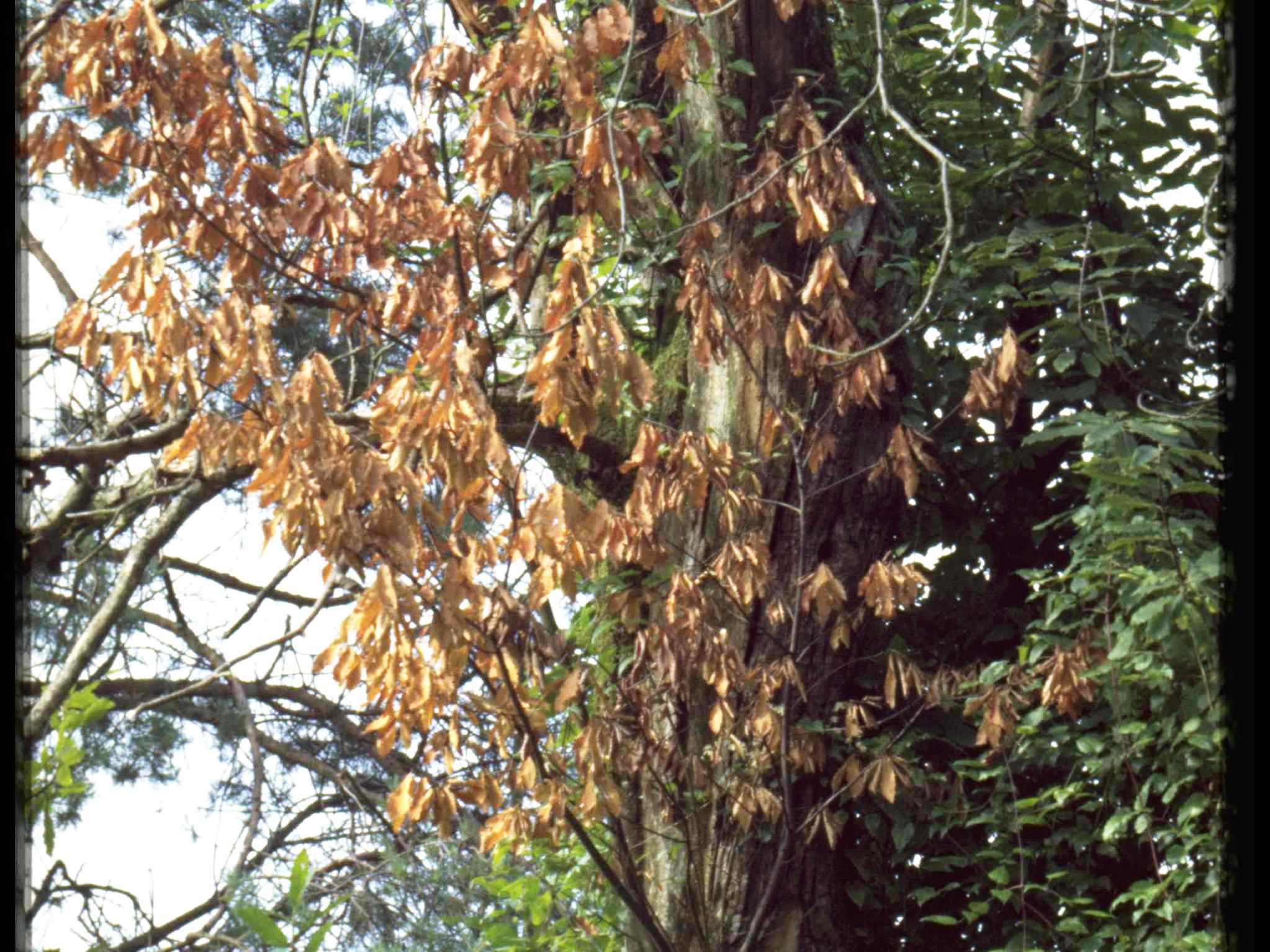
Picture: D. Rigling
Above the girdling canker, leaves wilt and turn brown, but remain hanging on the tree (above). Below the canker, branches have healthy foliage and, after a short time, new shoots are produced below the area of dead bark. It is common to find many cankers on a single tree.
On young, smooth-barked branches the cankered bark can be a bright brown, in contrast to the greenish colour of normal bark. On older stem infections, the discoloration or sunken nature of the infected bark is much less obvious. When the bark is killed rapidly the stem is girdled without any callus formation.
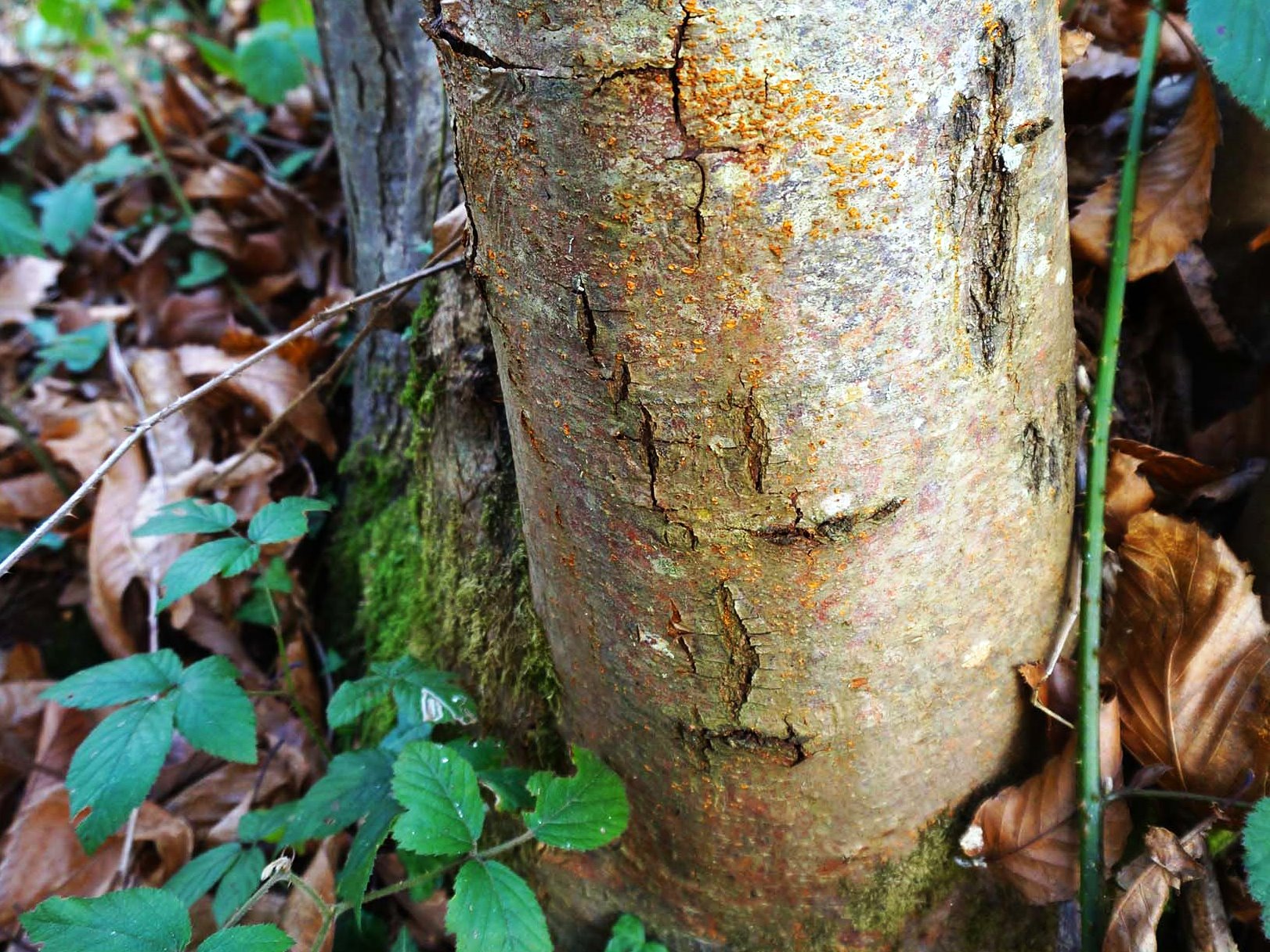
Picture: Forest Research/Crown copyright
However, sometimes the disease’s progress is slower, and new layers of bark form under the affected areas so that swelling and subsequent cracking of the outer bark occurs (above).
Another characteristic symptom is the formation of pale-brown mycelial fans in the inner bark, although these can only be revealed by cutting away the outer bark.
Some of the symptoms caused by C. parasitica infection, such as crown dieback, can also be caused by other pathogens, including Phytophthoras such as Phytophthora cambivora and P. cinnamomi. The latter is frequently associated with ‘ink disease’, named after a blue-black stain found around damaged roots. These pathogens are already present on a range of host plant species in the UK, and have been known for many decades to cause disease on sweet chestnut.
Other organisms which can be found in association with dieback and cankers on sweet chestnut include Gnomoniopsis smithogilvyi, Diplodina castaneae, Phytophthora ramorum and forms of Amphiporthe castanea (formerly known as Cryptodiaporthe castanea).
The following resources provide more images and information to help identify sweet chestnut blight.
Please note that the contact details on the Pest Alert have been superseded by those given on this page.
Report a sighting
Sweet chestnut blight is a regulated Quarantine Pest in the UK and any suspected findings must be reported. If, after studying the symptoms guides above, you think you have seen a case of sweet chestnut blight in Great Britain, please report it to us using TreeAlert.
Suspected sightings in Northern Ireland should be reported using TreeCheck, the all-Ireland tree disease reporting tool.
Please note that Tree Alert and TreeCheck both require digital photographs to be uploaded: these should be clear, well-lit, close-up pictures of symptoms.
You can also visit the Check a Sweet Chestnut campaign for more information on how to check for symptoms, a campaign delivered in association with Forest Research, the RHS, Defra, APHA, Forestry Commission, Observatree and Coventry University.
If you trade in plants in England or Wales and suspect sweet chestnut blight on your site, please inform your local Animal & Plant Health Agency (APHA) plant health and seeds inspector or contact planthealth.info@apha.gov.uk; tel: 0300 1000 313.
Spread
Long-distance spread of C. parasitica can occur through movements of infected sweet chestnut plants, wood or bark in trade.
Once bark has been colonised, the mycelium of the pathogen is reported to survive in this tissue for up to 10 months, even if it has been air dried. There is also a small risk of transmission by fruits or seeds.
Locally, the spores of C. parasitica are spread by wind and water, but might also be transmitted by other agents such as insects and birds. Entry into suitable tissue for infection might be aided by wounds produced by insects, including the Oriental chestnut gall wasp (Dryocosmus kuriphilus), which is present in South-East England. Early results from our research suggest that this might be happening at some sites in England.
It is also reported that the pathogen can exist as a saprotroph (that is, it lives and feeds on dead organic matter) on broad-leaved trees beyond its parasitic host range, allowing it to persist even when infected chestnut trees have been removed. Infection can also persist on cut timber, branches and woody material.
We are conducting research to improve understanding of the disease in the UK context. At most sites where sweet chestnut blight has been found, only a few trees are affected, and very few of these appear to have been killed.
Preventing and minimising spread
Spread of the disease is best prevented or minimised by:
- reporting any suspected findings immediately using our online portal TreeAlert or to your plant health inspector;
- not moving infected plants, bark or wood;
- practising high standards of biosecurity, such as washing and disinfecting tools, vehicles, equipment, footwear, clothing and vehicles after visiting or working at infection sites, and before visiting or working at new sites.
See also‘Regulation’ and ‘Official action’ below for details of regulatory measures designed to prevent or minimise further introductions and spread of sweet chestnut blight.
Regulation
C. parasitica is a regulated pest in the UK. Regulatory restrictions apply to importations of sweet chestnut material, including plants for planting, wood and bark, into the UK from all third countries. These regulations are intended to minimise the risk of further introductions of the disease into the UK. UK legislation also requires the use of UK plant passports for the movement of all Castanea species (including sweet chestnut) with bark and isolated bark of these species.
Guidance on these regulations is available on the UK Government website for:
On 26 March 2026, a new demarcated area was announced in Devon, coming into force on 2 April 2026.
Official action
Sweet chestnut blight was confirmed for the first time in the UK in November 2011, in a nut orchard in Warwickshire, England. This was traced back to imports of sweet chestnut from Europe. Since then we have identified a number of outbreak sites across England. Rigorous wider environment surveillance is carried out following findings to determine the extent of the disease.
Where confirmed findings are made, infection is managed through the application of statutory measures for eradication and containment.
A contingency plan for sweet chestnut blight was originally published in 2016 and updated in 2022. The Forestry Commission serve Statutory Plant Health Notices (SPHNs) on the owners of affected sites detailing biosecurity measures that must be taken. These can include requirements to remove and destroy all sweet chestnut trees. Movement restrictions at affected sites are applied on a site-by-site basis, taking account of the situation in each area based on the current policy approach.
The UK’s protections were strengthened in response to the 2011 findings, including a requirement that plants must originate from pest-free areas, that is, areas officially declared free of C. parasitica.
Biology
The C. parasitica fungus enters the tree through injuries in the bark. It spreads to the underlying vascular cambium and wood, killing these tissues as it advances. The flow of nutrients is eventually choked off to and from sections of the tree above the infection, killing the tree above ground. The spores which spread the disease to healthy trees are produced in the orange fruiting bodies which develop on the bark of infected trees.
Origins and background
Cryphonectria parasitica originated in eastern Asia, where it occurs on indigenous sweet chestnut species. However, it causes little damage to them because Asian sweet chestnut species have adapted and become tolerant to the fungus as a result of their long co-evolution with it.
The susceptibility of American chestnut became apparent soon after the first discovery of sweet chestnut blight in New York in 1904. Within 50 years the disease had spread over the entire native range of the American sweet chestnut, from Maine in the north to Georgia in the south, and west to Ohio and Tennessee, and into Ontario and British Columbia in Canada. The result was devastation of much of the estimated 4 billion American sweet chestnut population.
It is now widespread in Europe, except for countries with EU Protected Zone (PZ) status.
Sweet chestnut blight was first identified in the UK in 2011 in Warwickshire, England, and has subsequently been identified at a number of other sites across England.
Long-term prospects
There is evidence that the pathogen can weaken in virulence in Europe, allowing infected sweet chestnut plants to recover. This weakening or attenuation in virulence is due to a phenomenon known as hypovirulence.
Hypovirulence results when the C. parasitica fungus is infected by a naturally occurring virus called Cryphonectria hypovirus 1 (CHV1) which limits the ability of the pathogen to grow in chestnut bark, or to produce spores. Hypovirulence is used as a form of biological control in many European countries affected by chestnut blight.
It involves the application of hypovirulent strains of C. parasitica to trees affected with virulent, growing cankers. The treatment converts the virulent pathogen to a less aggressive form through the action of CHV1, and this allows the trees to recover from infection. There are now chestnut sites in Europe where the disease was introduced more than 30 years ago and where CHV1 is well established, so the blight severity is low.
However, the success of hypovirulence depends on having populations of C. parasitica with limited genetic diversity. Populations with high levels of genetic variation pose a significant obstacle to the spread of the hypovirus, and limit its effectiveness. This appears to be the main reason why hypovirulence has had only a limited impact in the USA, where C. parasitica populations are much more genetically variable.
Our scientific research into this pathogen continues. We are conducting significant studies with the Government of Jersey to help further inform development of a long-term strategy involving potential treatments using the CHV1 biological control agent to manage the disease at sites where eradication could be difficult: New research investigates potential biocontrol programme to manage sweet chestnut blight
Downloads

Contingency plan for sweet chestnut blight
PDF, 0.90 MB
A pest-specific contingency plan for Cryphonectria parasitica, produced by the Forestry Commission.