Summary
Why are bats important?
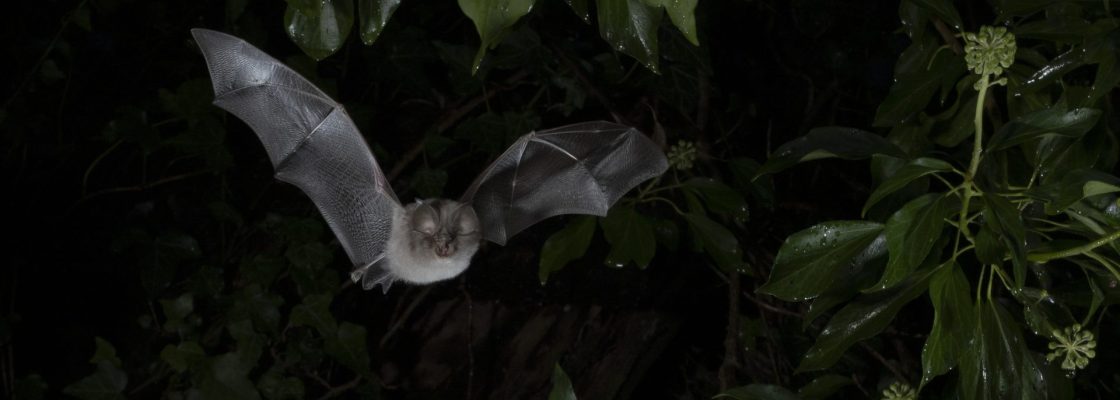
Bats are a vital component of the UK’s woodland ecosystems. All UK bats depend on woodland for foraging, roosting or commuting, making them powerful indicators of woodland biodiversity. Their wide distribution, sensitivity to environmental change, and position high in the food chain, mean fluctuations in bat activity can provide early signals about ecosystem health deterioration, land use pressures, and climate driven change.
How do we monitor them?
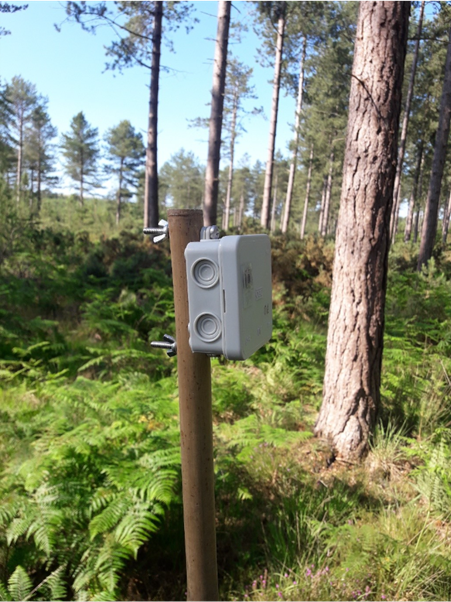
Since 2021, Forest Research and the Bat Conservation Trust (BCT) have partnered to deliver the UK’s largest woodland bat monitoring programme: the NCEA National Woodland Bat Survey (NWBS). Each year, cutting-edge acoustic sensors are deployed across up to 210 one-hectare National Forest Inventory woodland sites in England, capturing thousands of hours of acoustic recordings. These sounds are processed through the BCT Sound Classification System, where bat echolocation calls are automatically detected and classified to species, supported by expert manual verification.
What will we learn?
The survey aims to establish baseline estimates of bat species presence, distribution and relative abundance across England’s woodlands and to track trends in these measures over time. The species monitored represent around a quarter of all UK mammals, and the NWBS currently provides the only significant national-scale monitoring for three bat species included on the UK Red List of Threatened Species.
Measuring human impacts
Alongside the bat survey, the team is trialling emerging acoustic monitoring technologies and co-developing an innovative woodland soundscape classification algorithm to capture patterns of human recreation and activity within woodlands. Together, these methods and data provide an invaluable resource for researchers, conservationists, eNGOs, policymakers and practitioners working to understand and protect woodland biodiversity.
Research Objectives
England currently lacks a national-scale survey dedicated to monitoring bats in woodlands, despite bats being recognised as sensitive and effective indicators of woodland ecosystem health. The NCEA National Woodland Bat Survey was established in 2021 to address this gap by developing robust passive acoustic monitoring methods for woodlands and deploying them at scale.
This project aims to:
- Integrate national bat monitoring into the National Forest Inventory, enabling long‑term assessment of bat presence, distribution, and trends across England’s woodlands.
- Co-develop, test and apply a soundscape classification algorithm to detect and characterise anthropogenic sounds, improving our ability to measure human use of woodland environments.
- Explore the development and trial application of autonomous acoustic sensors capable of transmitting species and sound records over a network to enable continuous, long-term monitoring.

Future work: Investigate the potential of integrating this dataset with wider NCEA NFI+ and concurrent NFI survey data to create a powerful spatio‑temporal resource spanning multiple above‑ and below‑ground taxa, including the Environmental Improvement Plan (EIP) and Red List species (e.g. all UK bat species). This integration could unlock new insights into how woodland structure shapes biodiversity across woodland types and landscapes, helping to drive more targeted, evidence‑led forest management to support biodiversity recovery.
Latest Update
Unvalidated, example dataset
In 2025 we published an example dataset of unvalidated automated bat species classifications from acoustic recordings collected across three NFI sites. These raw classifier outputs naturally contain false positives, but are suitable for analyses where classification uncertainty can be directly modelled, and where the risk posed by individual misclassifications is low.
Validated dataset
We recently published an alternative multi-year dataset of validated and accepted species records.
Dashboard
Alongside the data we have also published an interactive dashboard for data exploration.
Our Involvement
The National Woodland Bat Survey is a project funded by the UK Government through Defra’s Natural Capital and Ecosystem Assessment programme (NCEA) with support from the Bat Conservation Trust. It is jointly led by Forest Research and the Bat Conservation Trust.
Further Information
View the Bat Conservation Trust website to access our Data Policy and Ethics Statement.
Author credit: Katherine Boughey, Lia Gilmour, Sophie Spurr and Chloe Bellamy.
Funding & Partners
- Funded by the UK Government through Defra’s Natural Capital and Ecosystem Assessment programme (NCEA) with support from the Bat Conservation Trust.
-

-

-