
Summary
What are the day-to-day benefits of forests and woodlands?
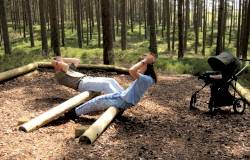
Health: A couple on the fitness trail in Camore wood. Dornoch FD.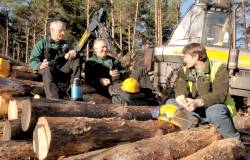
Livelihoods: Harvesting team having a break and an on-site meeting.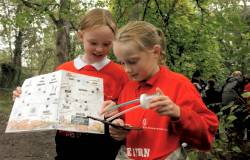
Education: School children examine samples on education project. Ellens Glen Woodland. Edinburgh.
Summary
Woodlands in Scotland provide the economy and local people with many benefits. But just how valuable are they and in what ways? Forest Research captured this value at the national (Scottish) scale, illustrated with local and regional insights from two contrasting case studies on how the benefits are experienced in the day-to-day lives of local people.
Key findings
- 13,200 full-time equivalent jobs linked to the use of Scottish timber
- 7,500 volunteers involved in forest-related activities
- £460 million gross value added (GVA) associated with Scottish timber
- 64% of Scottish children made a total of 11.6 million visits to Scottish woodlands in 2006-07
- Between 37 and 68 million visits to forests by Scottish adults every year
- Non-market value of visits to Scottish woodlands by Scottish adults estimated between £44 million and £76 million per year
- 1500 public events organised by the Forestry Commission in Scotland in 2006-07, involving around 134,000 visits
- 24% of Scottish children have visited woodland in the previous 12 months as part of a nursery or school trip (around 510,000 visits in total)
- Forestry Commission in Scotland works with around 20% of Scottish schools
- 5% of the Scottish adult population have attended an event in a wood that involved physical activity in the previous 12 months
- 82% of the Scottish adults agree that woodlands reduce stress and anxiety
- 79% of the Scottish adults agree that woodlands are places to exercise and keep fit
- Over half a million people in Scotland have visible woodland within 1 km of their homes
- About 95% of Scottish adults agree that woodlands in Scotland are an important part of the country’s natural and cultural heritage
Our Work
The research was carried out by an interdisciplinary team of 10 researchers from Forest Research. Their analysis used data collected from economic measures of the market and non-market benefits of forestry, two national Omnibus surveys, GIS techniques, questionnaire surveys of all known organisations in Scotland involved in forest-related activities, and two qualitative case studies of the Glasgow and Clyde Valley and Loch Ness regions.
Publications
Funders and partners
Jointly funded by the Forestry Commission and Forestry Commission Scotland
Status
2006-2008
Contact
General Content
Related pages
- About our research into people, trees and woodlands
- Evaluation and appraisal of the social dimensions of forestry